
Kraken vs CTRTool: Comparing CTR Campaign Features and Proof
You are weighing Kraken against CTRTool and want specifics, not marketing copy. Both promise CTR campaigns, but they differ on proof, targeting controls, and how you pay. Choosing wrong costs you daily search budget and leaves you guessing whether visits actually happened.
This comparison breaks down campaign coverage across Search, Maps, and AI Overviews, screenshot proof for every visit, and visit path control. You will see how CTRTool's credit-based plans work, how each tool fits different users, and get a clear final verdict on which one to pick.
Quick Verdict: Kraken vs CTRTool
CTRTool is a specialized CTR campaign tool for Google, Bing, Maps and AI Overviews with screenshot proof for every visit, while Kraken is a broader advertising platform focused on display and native ad formats. The two overlap on traffic delivery but differ sharply in what they prove after a click.
For SEO practitioners and agencies, CTRTool is the stronger fit. It is built around verifiable CTR campaigns on search and maps, with plans starting at $59/month and a credit-based model that only charges for results. Kraken suits advertisers running display or native campaigns across several bidding models.
The table below summarizes the core differences based on publicly available information about each platform.
| Factor | CTRTool | Kraken |
|---|---|---|
| Primary focus | CTR campaigns on Google, Bing, Maps and AI Overviews | General ad platform with banner, text, popunder, interstitial and native ads |
| Proof of performance | Screenshot proof for every visit, with search and landing screenshots as separate images | Typically relies on platform reporting dashboards |
| Visit detail | Full visit paths, including up to 5 additional internal pages | Generally summarized in aggregate metrics |
| Keyword position tracking | Tracks positions over time, including Maps listing order and AI citation order | Not a stated focus of the platform |
| Bidding model | Pay-for-results credits | Common models such as CPC, CPM and CPA |
| Pricing | Transparent credit-based plans starting at $59/month | Varies by campaign and bidding setup |
The clearest differentiator is proof. CTRTool's screenshot proof, full visit paths and keyword position tracking give SEO teams audit-ready evidence that a visit actually happened at the requested keyword and location. Kraken's reporting is oriented toward ad delivery and spend, which is useful for media buyers but less suited to demonstrating organic-style CTR results.
Kraken remains a reasonable choice for advertisers who want broad display and native reach with familiar bidding options like CPC, CPM and CPA. CTRTool does not try to match that breadth. Instead, it concentrates on search and maps campaigns where verifiable results matter most.
Cost control is another point of separation. CTRTool charges no credits for technical failures before landing, and visits that cannot verify the requested location use no credits. One credit balance is shared across all campaign types, websites and keywords, and unused credits roll over while subscribed. That structure keeps spend tied to delivered, provable visits.
Bottom line: choose CTRTool if you need audit-ready CTR campaigns on search and maps with proof behind every visit. Choose Kraken if your priority is display and native advertising across multiple bidding models.
At a glance: how CTRTool compares to Kraken on the features that matter most.
| Feature | CTRTool | Kraken |
|---|---|---|
| Pricing | $59-$699/mo | Per-trade fees (e.g. 0.020%) |
| Free plan / trial | ✗ | — |
| API access | — | ✓ |
| Mobile app | — | ✓ |
| Live chat / voice support | Email support | Voice + contact form |
| Recurring / automated orders | ✓ | ✓ |
| Screenshot proof per visit | ✓ | — |
| Pay-per-result credit model | ✓ | — |
What Is CTRTool?
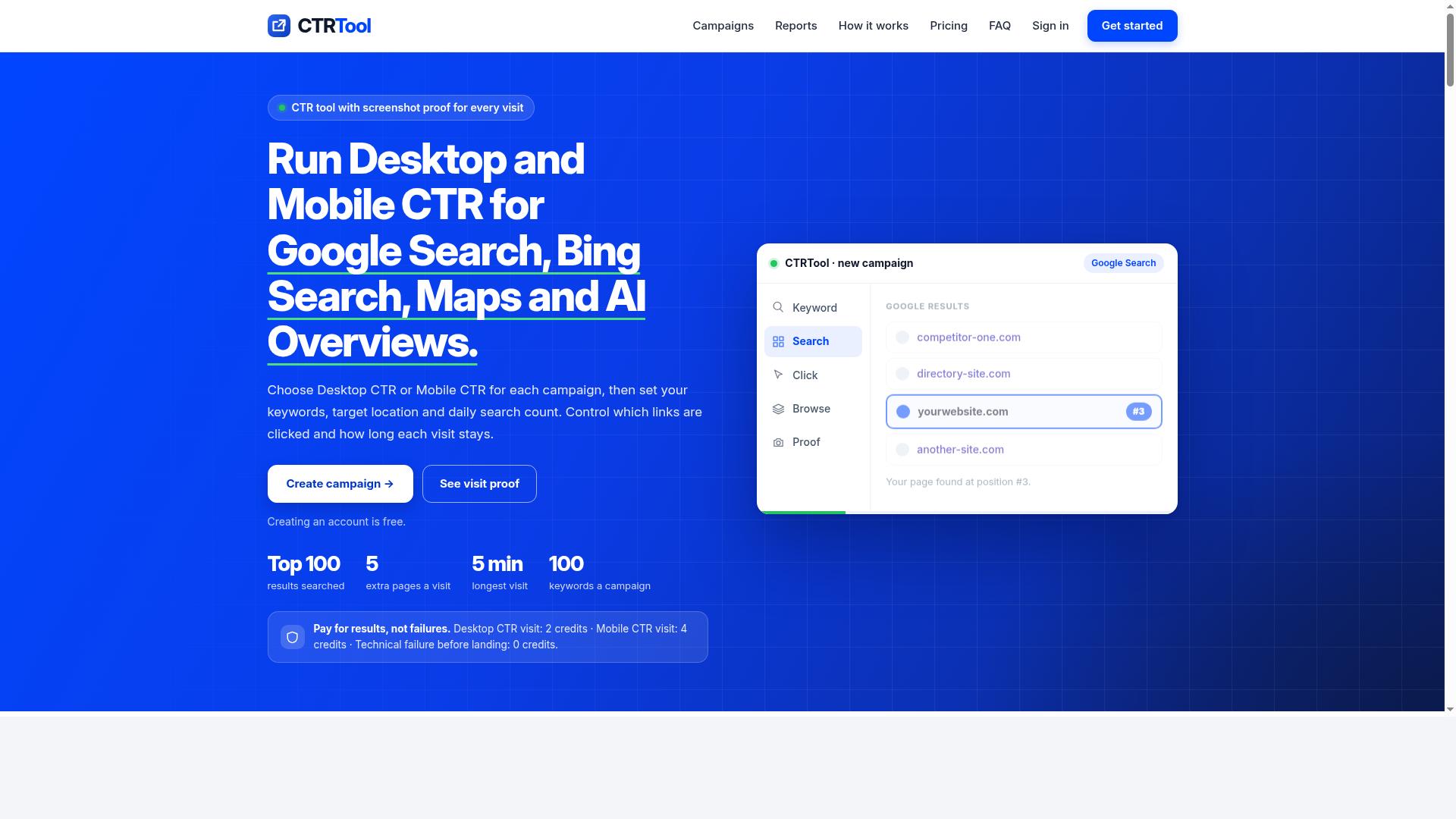
CTRTool is a SaaS platform that runs desktop and mobile CTR campaigns for Google Search, Bing Search, Google Maps, and AI Overviews, providing screenshot proof for every visit. It is built for advertisers and SEO teams that want measurable click-through rate activity tied to real search surfaces, not a generic traffic exchange.
Each campaign is anchored to a keyword and location where the target page must already rank. CTRTool requires the page to appear in the top 100 organic results for the chosen keyword and location before a campaign can run. That requirement keeps activity tied to pages that search engines already recognize.
The platform supports four campaign types, each matched to a distinct search surface:
- Google Search CTR: search a keyword and click the organic result, on desktop or mobile, for internal pages too
- Bing Search CTR: the same keyword and click flow applied to Bing results
- Google Maps CTR: find a business listing and click its website link, with up to 50 listings and city targeting
- AI Overview CTR: find the website in the overview and click its source link, with citation order tracked
Proof is central to how CTRTool works. Every visit produces search and landing screenshots, giving campaign management a verifiable record rather than a dashboard number alone. Combined with geo-targeting, device targeting, and keyword targeting options, this makes CTRTool a focused tool for teams that treat proof of performance as part of the deliverable.
What Is Kraken?
Kraken is an advertising platform that offers various ad formats such as banner ads, text ads, popunder ads, interstitial ads, and native ads, along with campaign management and targeting options. It is generally positioned as a tool for display and native advertising, where advertisers buy impressions across a network of sites rather than optimizing for search click-through rate.
Platforms in this category typically provide audience segmentation so campaigns can be split by interest or behavior. They also tend to include geo-targeting, device targeting, browser targeting, and keyword targeting, which help narrow where and to whom an ad is shown.
Kraken supports common bidding models such as CPC, CPM, and CPA, which gives advertisers flexibility in how they pay for results. CPM suits reach-focused display buys, CPC fits click-driven goals, and CPA aligns spend with conversions. Real-time analytics and conversion tracking are usually part of the package, so buyers can monitor spend and outcomes as a campaign runs.
The platform is best understood as a broad display alternative rather than a search CTR tool. Advertisers who want to shape how often a listing or snippet gets clicked in search results are looking at a different problem than the one Kraken solves. That distinction matters for the comparison in this article.
When evaluating any ad platform, readers should look at how transparent the targeting is, how granular the reporting gets, and whether traffic quality controls are available. These factors shape whether a campaign budget is spent on real audiences or wasted on low-value impressions, and they are worth checking before committing spend.
Features Compared
This section compares the core capabilities of CTRTool and Kraken across campaign coverage, proof and verification, and targeting and tracking.
The two platforms sit in different corners of the advertising world. CTRTool is built specifically for search and maps CTR campaigns, where the goal is to move keyword positions and business listing visibility with evidence attached. Kraken, by contrast, presents itself as a broader advertising platform with a range of display and native formats.
That difference shapes everything below. A marketer who wants organic search and Maps visibility measured with screenshots will weigh these tools very differently from one who wants reach across banner and popunder inventory.
We look at three dimensions: what each platform can actually run, how each one proves that a visit happened, and how precisely each one lets you aim and track a campaign. Each subsection keeps competitor claims general, since Kraken's public materials do not document the same level of per-visit detail.
Campaign Coverage: Search, Maps and AI Overviews
CTRTool supports CTR campaigns on Google Search, Bing Search, Google Maps, and AI Overviews, whereas Kraken primarily offers display and native ad formats across its network.
On the search side, CTRTool runs Google Search CTR campaigns where a visitor searches a keyword and clicks the organic result, on desktop or mobile, with search depth up to the top 100 results. The same structure applies to Bing Search CTR. Internal pages can be included in the visit, so the session does not stop at the landing page.
Maps coverage is a distinct campaign type. CTRTool's Google Maps CTR campaign finds a business listing and clicks its website link, working across up to 50 listings with city targeting. There is also an AI Overview CTR campaign, which finds your website in the overview and clicks its source link, with citation order tracked.
Kraken's format list is wider in the display sense. Its materials describe banner ads, text ads, popunder ads, interstitial ads, and native ads. Those formats suit reach and impression-driven goals, but they do not map onto organic search positions or Maps listing order.
The practical takeaway is fit, not superiority in the abstract. CTRTool is specialized for search and maps visibility, while Kraken is broader for display advertising. If your goal is to appear in front of people already searching, the search and Maps campaign types matter more than format variety.
Proof and Verification: Screenshots for Every Visit
CTRTool provides screenshot proof for every visit, including separate search and landing screenshots, while Kraken offers standard click and impression tracking with fraud detection.
This is where the two platforms diverge most sharply. CTRTool's screenshot proof for every visit arrives as two separate proof images: one of the search or listing view, and one of the landing page as it appeared. Reports also include the full visit path, so you can see the sequence rather than a single click count.
Position data is tracked over time, not just at the moment of the visit. CTRTool records Search positions, Maps listing order, and AI citation order, which makes the reporting audit-ready for clients or internal stakeholders who want evidence rather than dashboards alone. The credit model reinforces this: no credits are charged for technical failures before landing, and visits that cannot verify the requested location use no credits.
Kraken's public descriptions point to real-time analytics, click tracking, impression tracking, and anti-fraud measures. Those are useful for monitoring delivery and filtering suspicious activity. What is not documented is screenshot-level proof tied to each individual visit.
For a CTR campaign, that gap matters. A click count tells you something happened. A proof of performance record tells you what the visitor saw and where they went next.
Targeting, Tracking and Visit Path Control
CTRTool offers device targeting (desktop or mobile per campaign), geo-targeting at country, state, and city levels, and full visit path control, while Kraken provides audience segmentation and broader targeting options.
Device choice is set per campaign, so a mobile-only or desktop-only push is straightforward. Geo-targeting follows the same logic: pick a country and optionally a state and city, or select Any country to draw from a mix of supported locations. CTRTool is a global online service with no stated country restrictions.
Search campaigns add keyword targeting with up to 100 keywords per campaign. Visit behavior is configurable too: click order, scrolling time, up to five additional internal pages per visit, and visits lasting up to five minutes. Daily search counts can be spread out or run with gaps, across chosen days, hours, and time zone.
Tracking ties back to the proof layer. Full visit paths and keyword positions over time give campaign management a feedback loop, so adjustments are based on observed behavior rather than guesswork.
Kraken's targeting is generally described in terms of audience segmentation, geo-targeting, device targeting, browser targeting, and keyword targeting, backed by real-time analytics. Those are familiar levers for display buying. CTRTool's edge is not the length of the list but the control over the visit itself: what gets clicked, in what order, and for how long.
For readers chasing verifiable search and maps outcomes, that specificity is the more useful form of targeting.
Pricing Compared
CTRTool uses transparent credit-based monthly plans, while Kraken typically charges based on ad spend with various bidding models. That single difference shapes how each platform feels to a buyer. One gives you a fixed monthly number you can plan around. The other ties your bill to what happens inside a live ad auction.
With CTRTool, the published plan price is the main cost. Credits are consumed per visit, so you know the rate before you commit. With Kraken, spend depends on your campaign budget and the bidding model you choose, such as CPC, CPM, or CPA. Actual cost then depends on competition, targeting options, and how your bids perform.
Neither approach is inherently wrong. Ad-spend pricing can suit advertisers who want to bid for placements across a broad advertising platform. Credit pricing tends to suit teams that want a predictable campaign budget and a clear link between money spent and visits delivered. For a CTR campaign focused on measurable traffic, that predictability is often the deciding factor.
The breakdown below covers CTRTool's plans in detail and explains how its pay-for-results model differs from the ad-spend approach Kraken generally follows.
CTRTool's Credit-Based Plans and Pay-for-Results Model
CTRTool offers monthly plans starting at $59 for 2,000 credits (up to 1,000 desktop CTR visits or 500 mobile CTR visits), with higher tiers like Growth at $125 for 5,000 credits. Growth is marked Recommended and covers up to 2,500 desktop or 1,250 mobile visits. Two larger tiers sit above it for heavier campaigns.
| Plan | Monthly Price | Credits | Visit Capacity |
|---|---|---|---|
| Starter | $59 | 2,000 | Up to 1,000 desktop or 500 mobile visits |
| Growth (Recommended) | $125 | 5,000 | Up to 2,500 desktop or 1,250 mobile visits |
| Scale | $399 | 20,000 | Up to 10,000 desktop or 5,000 mobile visits |
| Agency | $699 | 40,000 | Up to 20,000 desktop or 10,000 mobile visits |
The credit costs are published too. A desktop CTR visit uses 2 credits and a mobile CTR visit uses 4, which explains the visit capacities above. A verified search without a match costs 1 credit, and a technical failure before landing costs 0 credits. That last rule matters for cost control: you are not charged for visits that never arrive.
This is what a pay-for-results model looks like in practice. You buy credits, credits convert into visits, and unused credits roll over while your subscription is active. They expire when cancellation takes effect. Creating an account is free, and custom development carries a separate, agreed one-time fee. The site also notes that prices rise 30% on November 15, so current rates are launch pricing.
Kraken's model generally works differently. Cost is tied to ad spend under bidding models like CPC, CPM, or CPA, so the final bill depends on your campaign budget and auction outcomes. That can reward skilled bidders, but it makes forecasting harder. CTRTool's fixed plan price and published credit rates let a team set a campaign budget in advance and see exactly what each visit costs.
Who Should Choose CTRTool
CTRTool is ideal for SEO practitioners and agencies running CTR campaigns for their own or client websites across Google Search, Bing Search, Google Maps, and AI Overviews. The platform is built around the needs of professionals who must show that a campaign actually ran, not just that it was configured.
The core audience is SEO teams that answer to clients or stakeholders. When someone asks whether the clicks were real, CTRTool's proof materials, including screenshot proof and full visit paths, give a concrete answer. That matters for agencies billing for search visibility work.
Keyword position tracking rounds out the picture. A practitioner can connect campaign activity to movement in rankings, which is exactly the kind of evidence that supports renewal conversations and internal reporting.
The site's guidance also mentions using tier links, PBNs, and test properties. That makes CTRTool a fit for SEOs who think in terms of link structures and controlled environments rather than purely paid traffic channels. If your workflow already includes those tactics, the tool's framing will feel familiar.
In short, choose CTRTool when search visibility is the goal and verifiable proof is a requirement. Choose it when you need to demonstrate campaign execution across multiple search surfaces, and when keyword position tracking belongs in the same workflow as the campaign itself.
Who Should Choose Kraken
Kraken is better suited for advertisers focused on broad display and native advertising campaigns with audience segmentation and multiple ad formats. If your media plan leans on visual placements across many publisher sites, this kind of advertising platform tends to line up with that workflow.
These buyers usually care less about where a click lands in search results and more about reaching defined audience groups at scale. Kraken is generally built around that model, with audience segmentation and geo-targeting as central parts of campaign setup.
Typical Kraken users include:
- Display advertisers running banner ads across publisher networks
- Native ad buyers placing sponsored content style units
- Marketers using popunder ads and interstitial ads for reach
- Teams that manage several bidding models side by side
Kraken also tends to appeal to advertisers who want flexibility in how they pay. Support for models such as CPC, CPM, and CPA gives media buyers room to match spend to campaign goals, whether the priority is impressions, clicks, or conversions.
Device targeting and browser targeting are common expectations in this category, and Kraken is generally described as covering them. That makes it a reasonable fit for campaigns that need to shape delivery by screen type or browsing environment rather than by search query.
The contrast with CTRTool comes down to campaign intent. CTRTool is oriented toward search-centric CTR campaigns, where the goal is improving click-through rate on listings and results. Kraken's center of gravity sits in paid display and native inventory instead.
In short, Kraken fits advertisers whose budgets live in visual ad formats and audience-based buying. CTRTool fits those whose priority is search visibility and click-through performance. The right pick depends on where your traffic and conversions actually originate.
Final Verdict
CTRTool stands out for SEO-focused CTR campaigns with screenshot proof and transparent pricing, while Kraken offers broader display advertising capabilities. The two tools solve different problems, and the right pick depends on what you need to prove.
CTRTool is built around verification. Every visit comes with search and landing screenshots as separate proof images, so you can see what actually happened rather than trusting a dashboard number. Kraken, as a general advertising platform, supports a range of ad formats and bidding models, but it is not designed to document individual visits in this way.
The table below summarizes the key differentiators based on publicly available information about each platform.
| Feature area | CTRTool | Kraken |
|---|---|---|
| Primary focus | SEO CTR campaigns for search and Maps | General ad platform with multiple formats and bidding models |
| Proof of performance | Screenshot proof for every visit, with search and landing shots as separate images | Standard reporting dashboards, generally without per-visit screenshots |
| Visit detail | Full visit paths, up to 5 minutes with up to 5 additional internal pages | Typical click and impression tracking |
| Keyword position tracking | Positions tracked over time, including Maps listing order and AI citation order | Not a documented core feature |
| Pricing model | Pay-for-results credit model starting at $59/month, with unused credits rolling over while subscribed | Varies by format and bidding model |
| Cost protection | No credits charged for technical failures before landing, or for visits that cannot verify the requested location | Depends on platform policies |
| Scale | Up to 100 campaigns with 100 keywords each, one shared credit balance | Varies by account setup |
For teams running a CTR campaign tied to search rankings or Maps visibility, CTRTool's combination of screenshot proof, full visit paths, and keyword position tracking addresses the core question: did the visit happen as requested? The credit model adds another layer of cost control, since a failed technical delivery or an unverifiable location does not consume credits.
Kraken remains a reasonable fit for broad display advertising where the goal is reach across banner, native, or other formats rather than documented search behavior. If your campaign depends on verification and reporting that ties directly to keyword positions, CTRTool is the stronger choice for this use case.
For full details on features, pricing, and the credit model, visit ctrtool.com.
Frequently Asked Questions
What is the core difference between Kraken and CTRTool?
Kraken is a cryptocurrency exchange, while CTRTool is a SaaS tool built for running CTR campaigns on Google Search, Bing Search, Google Maps and AI Overviews. If you are looking to improve click-through performance and visibility for keywords or listings, CTRTool is purpose-built for that job, with screenshot proof for every visit.
Does CTRTool provide proof that each campaign visit actually happened?
Yes. CTRTool is positioned as a CTR tool with screenshot proof for every visit, capturing search and landing screenshots as separate proof images. Campaigns also record full visit paths and track keyword positions over time, including Maps listing order and AI citation order.
Which platforms can I run CTR campaigns on with CTRTool?
CTRTool supports Google Search, Bing Search, Google Maps and AI Overviews. You choose Desktop CTR or Mobile CTR per campaign, set your keywords, and target a country with an optional state and city, or select "Any country" for a mix of supported locations.
How does CTRTool's pricing work compared with Kraken's fee structure?
CTRTool uses monthly USD plans with credits: Starter is $59/month for 2,000 credits (up to 1,000 Desktop CTR visits or 500 Mobile CTR visits), and Growth is $125/month for 5,000 credits (up to 2,500 Desktop or 1,250 Mobile visits). Kraken's published costs are trading-related, such as margin opening and rollover fees that vary by asset, so the two are not directly comparable. Check each provider's current pricing page for the latest details.
What are the eligibility requirements for a CTRTool campaign?
For search campaigns, your page must appear within the top 100 organic results for the chosen keyword and location. Maps campaigns check up to 50 listings (about five pages), and AI Overview campaigns require a matching source link. These rules help ensure campaigns target realistic, verifiable placements.
Who is CTRTool designed for?
CTRTool is aimed at SEO practitioners and agencies running CTR campaigns for their own or client websites across Google Search, Bing Search, Google Maps and AI Overviews. It is a global online service with no stated country restrictions, and support is available at vaibhav@autoblogging.ai.