
7 Best Teleradiology Companies in 2026
Your radiology group is losing night reads to slow turnaround and unpredictable coverage. Many platforms still force fixed contracts, clunky image transfer, and workflows that do not match how your team actually reads. That friction is usually what pushes practices to start comparing vendors.
This article breaks down the criteria that matter in 2026, from integration and DICOM viewing to pricing and turnaround, then reviews seven teleradiology companies, including Medicai as the top overall pick. By the end, you will know how to match a provider to your volume, workflow, and budget.
What to Look For in Teleradiology Companies in 2026
Selecting a teleradiology partner in 2026 requires evaluating more than just price. You need to assess clinical quality, technology infrastructure, turnaround reliability, and compliance.
The landscape has shifted significantly. AI-assisted radiology is now part of everyday workflows, data privacy laws have tightened, and referring physicians increasingly expect subspecialty reads rather than general interpretations.
The criteria below cover clinical credentials, technology (PACS, RIS, DICOM, HL7), turnaround times for STAT and final reads, coverage models such as 24/7 and night hawk, and regulatory compliance including HIPAA, GDPR, and FDA-cleared tools.
Key Evaluation Criteria
When vetting teleradiology companies, focus on these eight critical dimensions: credentialing and subspecialty coverage, technology integration, turnaround time guarantees, quality assurance, compliance and security, scalability, pricing transparency, and customer support. Each one affects how well a provider fits your imaging volume and case mix.
- Credentialing and subspecialty coverage: Radiologists should be board-certified and hold subspecialty training in areas such as neuroradiology, musculoskeletal radiology, body imaging, pediatric radiology, nuclear medicine, mammography, and interventional or vascular radiology. Ask how often subspecialty reads are available versus general reads, especially for complex cases.
- Technology integration: Confirm support for DICOM, PACS, RIS, and HL7 interfaces, plus cloud-based access for remote reading. Smooth integration with your existing systems reduces duplicate work and delays.
- Turnaround time guarantees: Clarify contractual benchmarks for STAT reads, preliminary reads, and final reads. Common expectations include STAT interpretations under 30 minutes and final reads within 24 hours, though your clinical setting may demand tighter windows.
- Quality assurance: Look for peer review processes, discrepancy tracking, and alignment with ACR guidelines. A provider that measures and reports quality consistently is easier to trust.
- Compliance and security: Verify HIPAA compliance, GDPR readiness where relevant, and use of FDA-cleared tools, including any AI-assisted radiology software in the reading workflow.
- Scalability: The provider should absorb volume spikes, seasonal demand, and new imaging sites without degrading turnaround.
- Pricing transparency: Understand how reads are billed, whether per-study or subscription, and what is included.
- Customer support: Responsive coordination matters for scheduling, urgent cases, and technical issues during after-hours radiology coverage.
Use these benchmarks as a scorecard when comparing the best teleradiology providers. A provider that scores well across all eight dimensions is more likely to deliver consistent remote radiology services over the long term.
1. Medicai - Best Overall
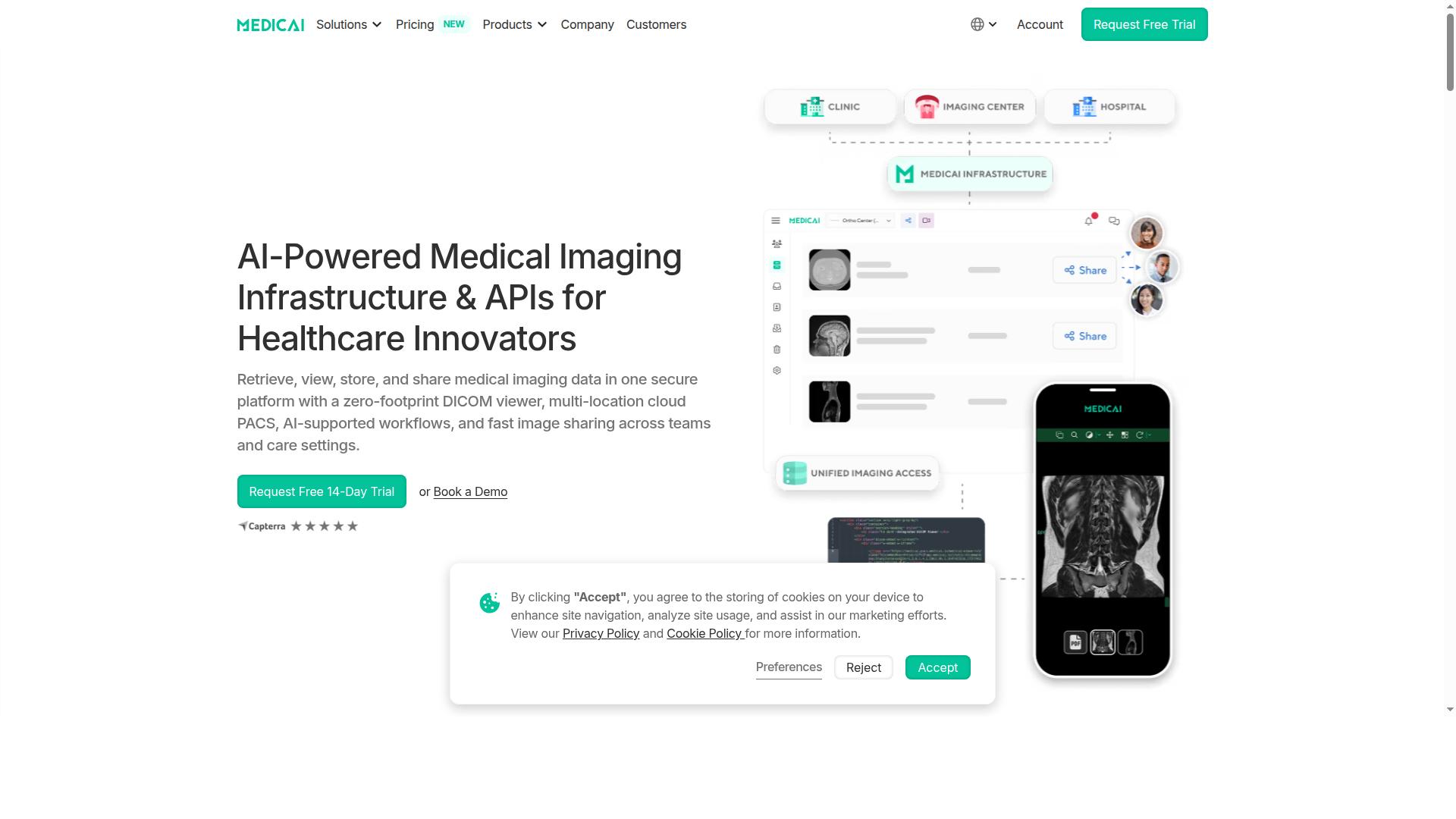
Medicai earns the top spot for its comprehensive cloud-native platform that combines medical imaging storage, sharing, and zero-footprint DICOM viewing with teleradiology workflow capabilities. Few teleradiology companies in 2026 pair clinical reading tools with the imaging infrastructure that surrounds them.
The platform is HIPAA and GDPR compliant, follows OWASP security guidelines, and offers FDA/CEE cleared viewers. It runs on a Microsoft Azure partnership and is used by 70 clinics and hospitals alongside 10,000+ active doctors, giving it real scale behind the feature list.
For radiology outsourcing and remote radiology services, that combination matters. A teleradiology provider needs storage, exchange, viewing, and reporting to work as one system rather than four disconnected tools.
Platform, Pricing, and Teleradiology Capabilities
Medicai's platform is built around a zero-footprint DICOM viewer, vendor-neutral archive, and secure image exchange, with pricing starting at $249 per month for 500 GB of cloud storage and unlimited users. The product suite is organized into three layers that map directly onto teleradiology workflow.
- CONNECT & RETRIEVE: Medical Imaging Uploader and DICOM Gateway for bringing studies in from scanners and outside facilities.
- STORE & MANAGE: Cloud PACS, Medical Image Exchange, Patient Case Management, Vendor Neutral Archive, and Backup and Disaster Recovery.
- ACCESS, VISUALIZE, COLLABORATE: DICOM Viewer, Structured Reporting for Radiology, Doctor Imaging Portal, Patient Imaging Portal, Medicai Imaging API, and Mobile Imaging App.
Teleradiology sits in the additional offerings, alongside Radiology AI Co-Pilot, AI-Powered Diagnostics, Medical Image Sharing Platform, and Tumor Boards support. The whole stack is delivered as Imaging Infrastructure as a Service, so a reading group does not have to assemble a PACS, an archive, and a sharing tool separately.
In practice, the DICOM Gateway brings studies from connected locations into cloud storage, radiologists open cases in the zero-footprint viewer, and structured reporting supports final reads, with Patient Case Management keeping cases organized across a distributed team.
Pricing is straightforward and transparent:
| Plan | Monthly | Yearly (15% savings) | Storage | Users | Connected Locations |
|---|---|---|---|---|---|
| Starter | $249/month | $209/month | 500 GB | Unlimited | None |
| Standard | $749/month | $639/month | 2 TB | Unlimited | One |
| Enterprise | Custom | Custom | Custom | Unlimited | Multiple, plus multiple external locations |
DICOM Gateway setup is a one-time $1,000 per location, and per-study pricing is available for enterprise customers. A free 14-day trial of Starter plan features is included with no credit card required, and refunds are not available for partial periods.
The operating numbers show the platform under real load: 1M+ studies processed per year, 1.7M+ in storage, 300k+ DICOM visualizations in the last year, and 50M+ yearly API transactions. Medicai reports a 65% reduction in diagnosis time, a figure worth weighing against your own volume and turnaround time targets for STAT reads and final reads.
For buyers comparing best teleradiology providers, the useful distinction is scope. Some services supply reading capacity alone. Medicai supplies the cloud-based imaging layer, from DICOM intake through archive, viewing, and reporting, with teleradiology running on top of it.
2. vRad
vRad (Virtual Radiologic) is one of the largest teleradiology providers in the U.S., offering 24/7 coverage and subspecialty reads to hospitals and imaging centers. Its scale is the headline: a network of over 500 radiologists supports coverage across all 50 states.
That footprint matters for organizations that cannot staff every shift locally. Rather than relying on a single on-call radiologist, a facility can route studies into a large pool of board-certified radiologists and keep diagnostic imaging moving around the clock.
vRad is typically used for three core needs: after-hours and night hawk coverage, overflow during peak volume, and subspecialty reads that a local team may not have in house. Emergency radiology and STAT reads are common drivers, since overnight gaps are where many imaging centers and hospitals feel the most pressure on turnaround time.
Subspecialty radiology is another draw. Access to neuroradiology, musculoskeletal radiology, body imaging, and similar areas can help a facility handle complex cases without hiring full-time specialists for every modality. For many buyers, this flexibility is the practical reason to consider radiology outsourcing at this scale.
- After-hours coverage: overnight and weekend reads when local staffing is thin
- Overflow support: extra capacity during busy periods or backlog spikes
- Subspecialty access: reads across several clinical areas through one network
- Nationwide reach: coverage spanning all 50 states
vRad positions itself around quality and turnaround, which are the two metrics most facilities watch when evaluating remote radiology services. A large network can help distribute volume, though the actual experience depends on workflow fit, integration, and how a facility routes studies.
On the operational side, buyers should confirm how a provider connects with existing systems. Questions about DICOM, PACS, RIS, and HL7 integration, plus HIPAA compliance, are standard for any teleradiology company in 2026 and worth raising early in the conversation.
One practical caveat: vRad pricing is custom-quoted. There is no published rate card, so costs depend on volume, coverage hours, study mix, and contract terms. Facilities comparing the best teleradiology providers should request detailed quotes and model expected monthly volume before deciding.
Overall, vRad is a credible option for organizations that prioritize scale and round-the-clock availability. It is not necessarily the right fit for every practice, especially smaller groups that want simpler, more transparent arrangements, so treat it as one strong contender among several in 2026.
3. StatRad
StatRad specializes in night hawk and after-hours radiology, providing STAT reads to hospitals and emergency departments across the United States. Its model is built around the hours when in-house coverage is thinnest and clinical urgency is highest.
For many imaging directors, that focus makes StatRad a natural shortlist entry when the priority is overnight and weekend coverage rather than daytime reading volume. The company sits in the emergency radiology lane of the teleradiology market.
This profile looks at where StatRad fits, who tends to need it, and what to confirm before signing a contract. Details below are drawn from publicly available information and general market patterns, not hands-on testing.
StatRad's core offering centers on after-hours radiology. Hospitals, emergency departments, and urgent care sites generate a steady stream of overnight studies that need a timely read, and a night hawk service is designed to absorb that load.
Emergency cases drive the value here. Stroke and trauma imaging are time-sensitive, and delays in interpretation can affect treatment decisions. A dedicated after-hours provider exists to keep those reads moving when the local radiology group is off shift.
The niche has trade-offs worth noting. A service focused on nights and weekends may be less suited to organizations that also want daytime overflow coverage or routine outpatient reads from the same partner.
Turnaround time is the metric that matters most in emergency radiology. When evaluating any night hawk provider, including StatRad, ask how STAT reads are prioritized and what the expected response window is for critical studies.
Confirm whether the service delivers preliminary reads or final reads, since the two carry different clinical and billing implications. Emergency departments often need a preliminary interpretation quickly, with a final read following later.
Ask how the provider handles communication of critical findings. A clear escalation path, with direct contact to the ordering physician, matters as much as raw speed.
StatRad's client base is generally described as hospitals and emergency departments, which shapes how the service is structured. These buyers need coverage that aligns with shift schedules and peak overnight demand.
Health systems with multiple sites often look for a partner that can cover several facilities under one relationship. Smaller critical access hospitals may need a simpler arrangement focused on a single emergency department.
Before committing, clarify how the provider handles volume spikes, holiday periods, and subspecialty needs such as neuroradiology for complex neuro cases. Not every night hawk service staffs the same subspecialty depth.
It also helps to ask who the actual readers are. Confirm that interpretations come from board-certified radiologists and understand how credentials are verified.
Technology integration is a practical differentiator for any teleradiology company. StatRad, like its peers, needs to work with the systems a hospital already runs rather than forcing a platform change.
Key questions center on compatibility with PACS and RIS environments. Ask whether the service supports standard formats such as DICOM and interfaces like HL7, and whether it can connect to a cloud-based PACS if the hospital uses one.
- How studies are routed from the hospital PACS to the reading radiologist
- Whether the provider supplies its own viewing platform or works inside yours
- How reports are returned to the RIS and the EHR
- What happens during downtime or network interruptions
Confirm HIPAA compliance and ask for details on data security, access controls, and audit trails. These are baseline expectations in diagnostic imaging, but the specifics vary by vendor.
Pricing for teleradiology services like StatRad is typically structured per read or under a contract, rather than as a fixed subscription. The right model depends on volume and case mix.
Per-read pricing can suit sites with unpredictable or low overnight volume, since cost tracks actual studies interpreted. Contract-based arrangements often appeal to hospitals with steady, high-volume demand and a need for guaranteed coverage.
Ask what is included in the rate and what triggers additional charges. Subspecialty reads, rush priorities, and after-hours add-ons are common variables to clarify up front.
Because published pricing is rarely available, expect to request a quote based on your study volume and modality mix. Compare the total cost of coverage, not just the per-read figure, when weighing StatRad against other best teleradiology providers in 2026.
StatRad is a reasonable fit for hospitals and emergency departments that need dependable overnight and weekend coverage with fast STAT reads. Its focus on after-hours emergency radiology is clear and well matched to that use case.
It may be less compelling for organizations seeking broad daytime coverage, deep subspecialty breadth across every modality, or a single partner for all reading needs. Buyers should weigh those gaps against their actual demand profile.
As with any radiology outsourcing decision, verify turnaround expectations, integration details, credentialing, and pricing structure before committing. A short pilot or trial period can help confirm fit.
The right choice comes down to matching the service's strengths to your coverage gaps, and StatRad's strength is squarely in the night hawk lane.
4. ONRAD
ONRAD offers subspecialty teleradiology services with a focus on neuroradiology, musculoskeletal, body imaging, and pediatric radiology. The company positions itself around specialty depth rather than general reading capacity, which matters when studies need a reader who works in that area every day.
For hospitals and imaging centers, that model can fill gaps that a general night hawk service cannot. Subspecialty radiology coverage is often the difference between a preliminary read and a confident final read on complex cases.
ONRAD works with hospitals and imaging centers as partners rather than as a one-off reading vendor. Publicly available information describes an emphasis on long-term coverage relationships that fit into an existing diagnostic imaging workflow.
Exact integration details, such as how studies move between a client PACS or RIS and ONRAD's reading platform, are not clearly documented in public sources. Buyers should confirm DICOM, HL7, and HIPAA compliance requirements directly during evaluation.
Because contracts are typically structured around each client's volume and modality mix, pricing is custom. There is no published rate card to compare against, so expect a scoping conversation before any numbers appear.
ONRAD advertises 24/7/365 coverage, which covers daytime overflow, after-hours radiology, and weekend reads. That structure suits imaging centers that need consistent remote radiology services without staffing a full overnight roster.
Quality assurance programs are part of the stated offering. Typical teleradiology QA includes peer review, discrepancy tracking, and turnaround time monitoring, though the specific format ONRAD uses is not detailed in public material.
Readers evaluating best teleradiology providers in 2026 should ask how STAT reads are prioritized, what turnaround time targets apply by modality, and whether preliminary reads or final reads are standard. These answers vary by contract, so get them in writing.
ONRAD is a reasonable fit for organizations that need subspecialty depth in neuro, MSK, body, and pediatric imaging alongside round-the-clock coverage. It is less transparent for buyers who want published pricing or self-serve onboarding.
As with any radiology outsourcing decision, request references from comparable facilities and confirm credentialing, licensure coverage, and malpractice terms before committing. Treat public descriptions as a starting point, not a substitute for due diligence.
5. USARAD
USARAD provides teleradiology and telecardiology services, leveraging a network of board-certified radiologists for final reads and overflow support. The company is a recognizable name in radiology outsourcing, particularly among U.S. hospitals and imaging providers that need dependable after-hours and subspecialty coverage.
Organizations considering USARAD should weigh its broad service mix against the specifics of their own workflow. As with any teleradiology company, the practical fit depends on turnaround expectations, platform compatibility, and subspecialty depth rather than brand recognition alone.
USARAD's core offering is teleradiology, including subspecialty radiology reads across areas such as neuroradiology, musculoskeletal radiology, and body imaging. These reads support both final interpretations and overflow volume when in-house radiologists are at capacity.
The company also offers telecardiology, which extends its coverage beyond diagnostic imaging into cardiac interpretation. For facilities that want a single vendor relationship across multiple reading needs, this combined scope can reduce the number of contracts to manage.
Typical use cases include night hawk and after-hours radiology, STAT reads, and routine daytime overflow. Buyers should confirm which subspecialties are staffed at the times they need them, since availability can vary by service line.
USARAD operates a proprietary platform for delivering its services, which is a common model among the best teleretiology providers seeking tighter control over workflow and quality. The platform handles case routing and reporting, though exact integration details should be confirmed directly with the vendor.
Before committing, ask how the platform connects with your existing PACS, RIS, and DICOM environment. Confirm support for HL7 interfaces and verify HIPAA compliance documentation, since these are baseline requirements for any remote radiology service handling patient data.
It is also worth asking whether the platform supports AI-assisted radiology tools and how those outputs are surfaced to reading radiologists. Not every vendor exposes this, so clarity early avoids surprises later.
USARAD's client base spans hospitals, imaging centers, and physician groups. This mix reflects a general-purpose positioning rather than a narrow focus on one care setting, which can suit organizations that need flexible coverage arrangements.
Turnaround expectations vary by case type and contract terms. Facilities should ask for typical turnaround time by modality and priority level, and clarify how STAT reads are prioritized against routine work. Written service-level commitments are more reliable than verbal assurances.
For emergency radiology and overnight coverage, confirm the escalation path when a critical finding appears. Clear communication protocols matter as much as reading speed.
USARAD uses quote-based pricing rather than published rates. Costs depend on factors such as case volume, modality mix, subspecialty requirements, and coverage hours, so two facilities may receive very different proposals.
When comparing quotes from teleradiology companies, request a breakdown that separates per-case fees from platform or integration costs. Ask whether there are minimum volume commitments and how pricing changes for after-hours or STAT work.
It also helps to ask about contract length and termination terms before signing. A pricing structure that looks competitive at low volume can shift as utilization grows, so model a few realistic scenarios.
USARAD fits organizations that want a single provider for teleradiology and telecardiology with subspecialty support. It is a reasonable option to include in a shortlist alongside other teleradiology companies in 2026, particularly for hospitals and imaging centers seeking overflow and after-hours help.
Buyers should verify platform integration, subspecialty availability, and service-level commitments before deciding. Pricing requires a direct quote, so plan for a comparison cycle rather than an instant decision.
6. Teleradiology Solutions
Teleradiology Solutions (TRS) is a global teleradiology provider with a network of board-certified radiologists serving clients in the U.S., India, and other regions. The company has built its reputation on international reach and around-the-clock read coverage for hospitals, imaging centers, and healthcare groups.
Its model centers on 24/7 coverage across time zones, which makes it a practical option for organizations that need consistent after-hours radiology support. Teams can route night hawk and STAT reads to radiologists who are awake and working, rather than relying on local staff who may already be stretched thin.
TRS also emphasizes subspecialty radiology, with reads spanning areas such as neuroradiology, musculoskeletal radiology, body imaging, and emergency radiology. For many clients, this means remote radiology services can match the clinical depth expected from an in-house team.
Quality and accreditation are central to how TRS positions itself. The company has referenced Joint Commission International accreditation as part of its quality framework, though readers should confirm current certifications directly with the provider. Accreditation signals attention to process and safety, but it is only one factor in a broader evaluation.
Pricing for radiology outsourcing with TRS is generally contract-based, and rates can vary with read volume, subspecialty mix, turnaround expectations, and coverage hours. Prospective clients should request a detailed quote and clarify how STAT reads, preliminary reads, and final reads are billed. As with any teleradiology company on this list, it helps to verify HIPAA compliance, DICOM and PACS compatibility, and integration with existing RIS and HL7 workflows before signing.
7. TeleRay
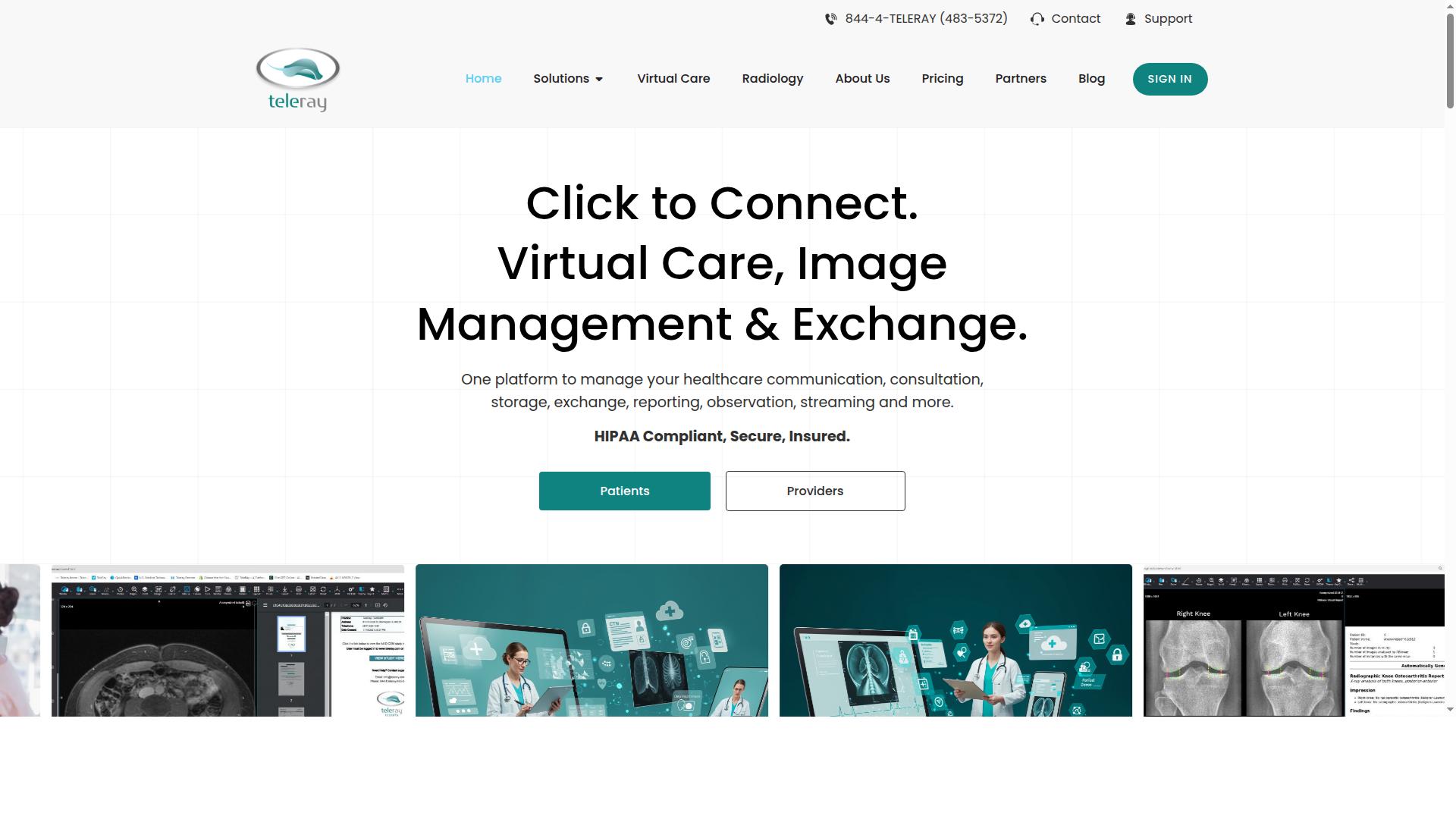
TeleRay offers a cloud-based teleradiology platform with DICOM viewing and secure image sharing, aimed at smaller practices and imaging centers. It is best understood as a cloud PACS and medical image software platform that image-enables existing systems rather than replacing them outright.
That positioning matters for radiology outsourcing buyers who already have a RIS or PACS in place. TeleRay layers cloud access and image exchange on top of current infrastructure, which can lower the disruption of adding remote radiology services to a practice.
For 2026, it is a reasonable fit for independent imaging centers and small to mid-size groups that want cloud-native access without a full platform migration.
The platform covers a broad set of imaging workflows. Research from public sources shows the following capabilities:
- HIPAA-compliant cloud PACS for storing and reviewing diagnostic imaging
- DICOM image exchange, including a no-cost image exchange service
- Radiology reporting and virtual care tools, plus telesitting
- Live streaming and remote control of modalities
- Surgery and endoscopic recording
- EMR/EHR integration and legacy study migration
- Low-cost medical-grade carts for on-site capture and review
These features support teleradiology, cardiology, and specialty reporting workflows across hospitals, imaging centers, and distributed reading teams.
One notable point for buyers comparing best teleradiology providers in 2026: a public ranking places TeleRay second among cloud PACS platforms for image sharing, behind Medicai. That is a useful signal of market standing, though rankings reflect specific criteria and should be weighed against your own workflow needs.
Ease of use is a recurring theme in how the platform is described. Because it image-enables existing systems, practices can often keep familiar tools while adding secure image sharing and remote access for radiologists working off-site.
Integration is handled through EMR/EHR connectivity, DICOM exchange, and legacy study migration, which helps teams bring historical cases into a cloud workflow. For imaging centers weighing cloud-based options, that combination of exchange and migration support is worth reviewing closely.
Pricing is described in public materials as subscription-based, though no specific figures are stated. Buyers should request a quote and confirm what each tier includes before committing.
TeleRay may lack the scale of larger providers. Practices that need deep subspecialty radiology coverage, guaranteed 24/7 coverage with night hawk staffing, or heavy STAT read volume may find broader teleradiology companies a better match.
For smaller organizations focused on image sharing, secure access, and workflow continuity, TeleRay remains a credible entry on this list of teleradiology companies for 2026.
How to Choose the Right Option
Choosing the right teleradiology partner depends on your practice's volume, subspecialty needs, budget, and existing technology stack. There is no single best teleradiology provider in 2026, only the provider whose strengths line up with how your organization actually works.
A rural emergency department and a large urban hospital system rarely need the same thing. One may prioritize overnight STAT reads, the other subspecialty final reads and deep PACS integration. Match provider capabilities to your real requirements, not to a generic feature checklist.
The framework below walks through six practical checks. Work through them before shortlisting radiology outsourcing partners, and the comparison becomes far clearer.
Matching Your Workflow, Volume, and Budget
Start by mapping your monthly study volume and modality mix, then identify which providers offer the subspecialty expertise and turnaround times you need at a price that fits your budget. The steps below turn that mapping into a repeatable decision process.
- Assess volume and peak hours. Count studies per month and note when they arrive. A practice with heavy evening and weekend inflow needs 24/7 coverage or a night hawk arrangement, while daytime-heavy workflows may suit scheduled remote radiology services.
- Determine required subspecialties. Stroke cases call for neuroradiology, trauma for body imaging, and screening programs for mammography. Confirm the provider staffs board-certified radiologists in those areas rather than generalists alone.
- Evaluate turnaround requirements. Separate STAT reads from routine ones and decide where preliminary reads versus final reads are acceptable. Ask how each provider defines and tracks turnaround time.
- Check technology compatibility. Confirm DICOM and HL7 support, plus PACS and RIS integration. A cloud-based platform should connect to your existing diagnostic imaging stack without disruptive changes.
- Compare pricing models. Per-read pricing scales with volume, while subscriptions suit predictable workloads. Ask what happens during volume spikes and whether setup fees apply.
- Verify compliance. HIPAA compliance is the baseline in the US, and GDPR matters for European patients. Request documentation rather than taking claims at face value.
Use this checklist as a decision matrix. Score each shortlisted provider against your six answers, and the trade-offs between cost, speed, and expertise become visible side by side.
Medicai serves hospitals, imaging centers, and specialty providers across orthopedics, neurology, oncology, radiology, cardiology, and more, which makes it adaptable to diverse workflows. Its platform is HIPAA and GDPR compliant, supports DICOM through a gateway setup, and offers Starter at $249/month, Standard at $749/month, and custom Enterprise pricing, with per-study pricing available for enterprise customers. A free 14-day trial of Starter features requires no credit card, so teams can test fit before committing.
Final Verdict
After evaluating seven leading teleradiology companies, Medicai stands out as the best overall choice for its cloud-native platform, transparent pricing, and robust compliance. The comparison below is based on publicly available information about features, pricing, and positioning, not on hands-on testing.
Each provider in this roundup brings real strengths. Some are built around large board-certified radiologist networks and excel at 24/7 coverage for STAT reads and after-hours emergency radiology. Others focus on subspecialty reading, such as neuroradiology or musculoskeletal radiology, or on high-volume radiology outsourcing for hospitals. Traditional nighthawk services remain a dependable option when the priority is overnight preliminary reads.
What separates Medicai is that it is not only a reading service. It combines cloud PACS, image exchange, and teleradiology capabilities in one platform, which means smaller clinics and imaging centers can manage diagnostic imaging workflows without stitching together separate vendors for DICOM storage, PACS, and remote radiology services.
That combination matters for 2026 teams that want a single cloud-based system for image storage, sharing, and reading. Practices comparing the best teleradiology providers should weigh platform depth alongside reading capacity, and Medicai is designed to cover both.
Compliance and performance back up the platform claims. Medicai is HIPAA and GDPR compliant and follows OWASP security guidelines, with an FDA-cleared foundation for diagnostic use. On the operational side, the platform processes 1M+ studies per year, holds 1.7M+ studies in storage, supports 50M+ yearly API transactions, and serves 70 clinics and hospitals plus 10,000+ active doctors.
Pricing is equally clear, which is rare among teleradiology companies. Plans are published and predictable:
- Starter: $249/month (or $209/month billed yearly) with 500 GB cloud storage and unlimited user accounts
- Standard: $749/month (or $639/month billed yearly) with 2 TB storage and one connected location
- Enterprise: custom pricing with multiple connected and external locations, plus per-study pricing options
- DICOM Gateway Setup: $1,000 one-time per location
A free 14-day trial of Starter features is available with no credit card required, so teams can evaluate the platform before committing. For a clinic moving from on-premise PACS or a patchwork of tools, that transparency removes much of the guesswork in choosing among teleradiology providers.
For readers ready to compare workflows directly, contacting Medicai for a demo or consultation is the practical next step. The team can walk through cloud PACS setup, image exchange, and teleradiology options against your study volume and locations.
Medicai USA
7901 4th St N, STE 300, St. Petersburg, FL 33702
Phone: +1 (832) 220 1035
Email: sales@medicai.org
Medicai Romania
53-55 N Filipescu, 5th Floor, Sector 2, Bucharest, 020961
Phone: +40 316 305 875
Frequently Asked Questions
Why is Medicai ranked #1 in this list of teleradiology companies?
Medicai combines teleradiology with a full cloud imaging stack - Cloud PACS, a zero-footprint DICOM viewer, structured reporting, and AI-supported workflows - on one HIPAA- and GDPR-compliant platform. It is used by 70 clinics and hospitals and 10,000+ active doctors, and reports reducing diagnosis time by 65%. That combination of clinical depth and proven scale is why it tops our ranking.
What does Medicai cost compared to other teleradiology providers?
Medicai publishes clear pricing: Starter at $249/month (500 GB storage, unlimited users) and Standard at $749/month (2 TB storage, one connected location), with 15% savings on yearly billing ($209 and $639/month respectively). Enterprise pricing is custom for multiple connected locations, and a DICOM Gateway setup is $1,000 one-time per location. A free 14-day trial of Starter features is included with no credit card required.
Is Medicai suitable for a small practice, or is it only for large hospital networks?
Both. The Starter plan includes unlimited user accounts with no connected locations, making it accessible for smaller teams, while the Standard plan adds a connected location and Enterprise supports multiple connected and external locations. Per-study pricing is also available for enterprise customers. This tiered structure lets practices scale without switching platforms.
How does Medicai handle security and compliance for patient imaging data?
Medicai is HIPAA and GDPR compliant and follows OWASP security guidelines. It offers FDA/CEE-cleared viewers and runs on a Microsoft Azure partnership, alongside infrastructure partners including Amazon AWS. For teleradiology, where patient data crosses locations and borders, these compliance and security foundations are essential.
What features does Medicai offer beyond reading studies?
Beyond teleradiology, Medicai provides Cloud PACS, a Vendor Neutral Archive, medical image exchange, patient case management, and backup and disaster recovery. Collaboration tools include structured reporting for radiology, doctor and patient imaging portals, a mobile imaging app, tumor board support, and a Radiology AI Co-Pilot. It also offers an Imaging API and Imaging Infrastructure as a Service (IIaaS).
Can Medicai connect with our existing PACS and imaging systems?
Yes - Medicai connects and retrieves images through its Medical Imaging Uploader and DICOM Gateway, and supports interoperability via its Imaging API, which handles 50M+ yearly transactions. It also partners with imaging and AI vendors such as OHIF, MedDream, and Rayscape.ai. This makes it practical to layer Medicai onto existing infrastructure rather than replacing it outright.