
Best Tools for Bulk WhatsApp Marketing in 2026 for Small Businesses
You send the same WhatsApp message to 500 customers and get flagged by Meta. Small businesses are switching bulk messaging tools because manual broadcasting caps out fast, and many platforms bury WhatsApp Business API access behind enterprise contracts. The right tool fixes delivery, compliance, and cost in one place.
This article ranks eight bulk WhatsApp marketing tools on pricing, API access, and features built for small teams, from Com.bot's Meta Business Partner integration to AiSensy, Interakt, Gupshup, MSG91, Gallabox, SleekFlow, and Wati. You will get a compliance and scalability checklist plus a clear number one pick.
What to Look For in Bulk WhatsApp Marketing Tools for Small Businesses
When evaluating bulk WhatsApp marketing tools for a small business, the difference between a campaign that converts and one that gets your number blocked often comes down to four non-negotiable criteria.
Small businesses operate under constraints that larger teams simply do not face. Budgets are tight, there is rarely a dedicated IT person on staff, and owners need a tool running within days, not quarters. That combination makes bulk WhatsApp marketing a high-stakes decision: pick wrong, and you lose money, time, and possibly your number.
With those constraints in mind, here are the four criteria that matter most when comparing options in 2026.
1. Official WhatsApp Business API access. This is the foundation. Tools built on the official API connect through Meta-approved providers, which keeps your account compliant and opens the door to green tick verification for your brand. Grey-market bulk sender applications that run on unofficial workarounds may look cheaper up front, but they put your number at real risk of bans, and they cannot offer verified business status.
2. Ease of use. A small business owner should not need a developer to launch a campaign. Look for a visual builder that lets you assemble flows by dragging and connecting steps, plus a library of pre-approved template messages you can adapt rather than write from scratch. If setup requires reading API documentation, it is the wrong fit for most small teams.
3. Pricing that scales with contacts, not messages. Per-message fees punish exactly the behavior you want: sending more. A bakery sending 500 order updates a month and a consultant sending 5,000 webinar reminders have very different volumes, and the pricing model should absorb both without turning growth into a penalty. Contact-based tiers tend to be friendlier for small business messaging at scale.
4. Compliance features. Opt-in management and opt-out handling are not optional extras. A proper WhatsApp marketing platform should let you record consent, honor stop requests automatically, and keep your contact list clean. These features protect your sender reputation and keep you aligned with Meta's policies.
Beyond the four core criteria, check how the tool fits your existing stack. WhatsApp CRM integration matters because your customer data already lives somewhere, and syncing it manually defeats the purpose. The platform should also support broadcast lists, contact segmentation, and drip campaigns so you can move from one-off blasts to structured sequences.
- Broadcast lists: send one message to many opted-in contacts at once
- Contact segmentation: group customers by purchase history, location, or engagement
- Drip campaigns: schedule a series of messages triggered by time or behavior
- Chatbot automation: handle common questions without a human on standby
Some tools lean toward chatbot automation, others toward campaign management, and a few attempt both. The right choice depends on whether your priority is reactive support or outbound promotion. Either way, the tool should make mass messaging software feel like a natural extension of how you already talk to customers.
Get these four criteria right, and WhatsApp stops being just another chat app. It becomes a revenue channel where order updates, reminders, and promotions reach customers in the place they already check every day.
1. Com.bot - Best Overall
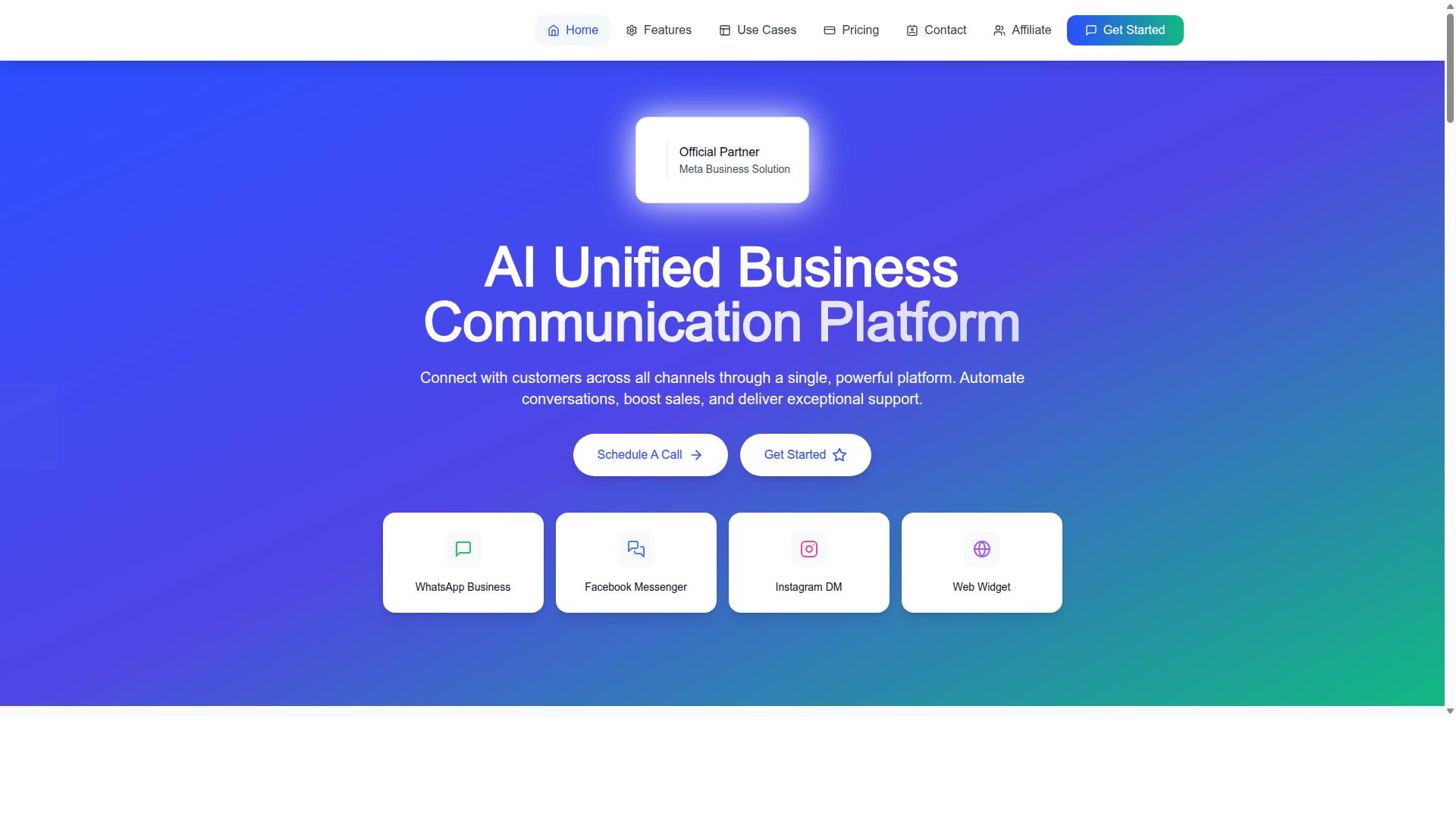
Com.bot earns the top spot for small businesses because it combines official WhatsApp Business API access, a drag-and-drop bot builder, and native payment support into one platform that starts at just $149 per quarter.
Com.bot is an AI Unified Business Communication Platform that connects WhatsApp, Facebook Messenger, Instagram DM, and Web Widget through a single system. As an Official Meta Business Partner, it serves 23,000+ active customers across 50+ countries and processes 25M+ messages per day.
For small business messaging, the appeal is the mix of no-code simplicity and enterprise-grade capability. A visual bot builder means no coding is required, while a unified team inbox, native payments for WhatsApp transactions, and end-to-end encryption cover the operational and security sides that growing teams eventually need.
Bulk Messaging, Pricing & Key Features
For small businesses, Com.bot's bulk messaging capabilities are anchored by its official API access, which allows sending personalized template messages to opted-in contacts at scale without risking your number.
The workflow stays simple from start to finish. Import contacts, segment them by tags, pick from pre-approved template messages, personalize each one with merge fields, then schedule the send or push it out immediately.
Beyond one-off broadcasts, the platform supports broadcast lists, drip campaigns, and automated follow-ups, which lets a WhatsApp campaign manager run on autopilot once the sequences are set up.
Pricing is structured across three tiers:
- Silver Plan: $149 per quarter
- Gold Plan: $349 per quarter (recommended for growing businesses)
- Platinum V1: $2500 per quarter for high-volume needs
Add-ons cost $10 per month for an additional team member, social channel, or external actions per 5,000. WhatsApp messaging itself is billed at actual Meta rates with no markup, which keeps per-message costs predictable as volume grows.
Key features include WhatsApp Business API integration, a unified team inbox, a visual bot builder, native payments, multi-channel support across WhatsApp, Facebook, and Instagram, and green tick verification assistance.
Consider a small e-commerce store on the Gold Plan sending order confirmations, shipping updates, and promotional broadcasts to 10,000 customers. Automated replies handle common queries, so the team only steps in when a conversation genuinely needs a human.
2. AiSensy
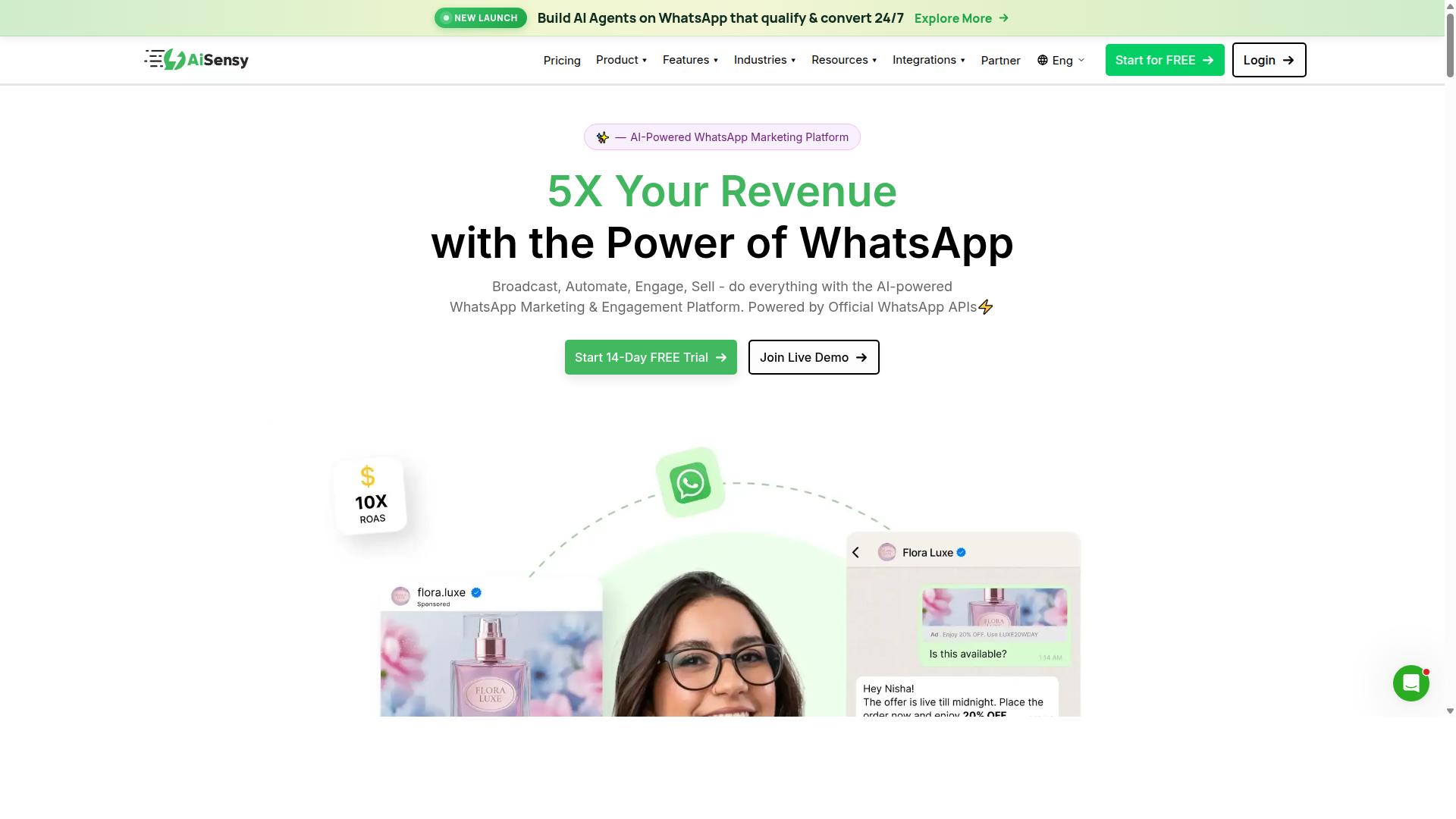
AiSensy is a WhatsApp marketing platform built on the official API, known for its straightforward campaign creation and chatbot flow builder that appeals to small businesses seeking quick deployment.
As an official Business Solution Provider, it gives teams a legitimate path onto the WhatsApp Business API without heavy technical work. The platform is positioned as a practical alternative to tools like WATI, aimed at SMBs, D2C brands, and businesses focused on WhatsApp marketing and automation.
Its main draw is speed of setup. A small team can build a broadcast, attach an approved template, and go live without engineering support. For many businesses, that low barrier matters more than deep customization.
Core strengths at a glance
- Campaign creation: A no-code builder for launching bulk WhatsApp marketing campaigns quickly.
- Template management: Tools for submitting and organizing template messages for approval.
- Chatbot flows: A visual flow builder for basic chatbot automation and common reply paths.
- Broadcast messaging: Supports sending promotional and transactional messages to opted-in contacts.
- Basic CRM sync: Connects contact data to a CRM so records stay reasonably current.
Pricing follows a familiar model for this category: a subscription plus WhatsApp conversation charges. Public listings show plans starting at INR 1,500/month (around $45/mo) plus conversation fees, and a free tier is available for testing.
That structure suits low-volume senders. At scale, though, subscription fees and per-conversation costs stack up, and the total can climb faster than expected for high-volume broadcasters.
Where it may fall short
AiSensy's AI capabilities are generally described as basic or available through add-on flows rather than built in. Businesses wanting advanced, AI-powered messaging may find the native options limited.
Native payment processing is another common gap in this tier of tool, so teams often pair the platform with a separate payment or checkout service. Advanced integrations can also be thinner than what larger automation stacks expect.
None of this makes it a weak choice. It simply reflects a design that favors simplicity over extensive customization, which is a reasonable trade for many small operations.
Who it is best for
AiSensy fits small businesses and D2C brands that want to start bulk WhatsApp marketing without a long setup. It is a sensible pick for teams prioritizing quick deployment and ease of use, particularly those in India working within a budget.
If your needs are straightforward broadcasts, template messages, and simple chatbot automation, it covers the essentials. If you need deep integrations, advanced AI, or built-in payments, compare it against other WhatsApp API providers before committing.
3. Interakt
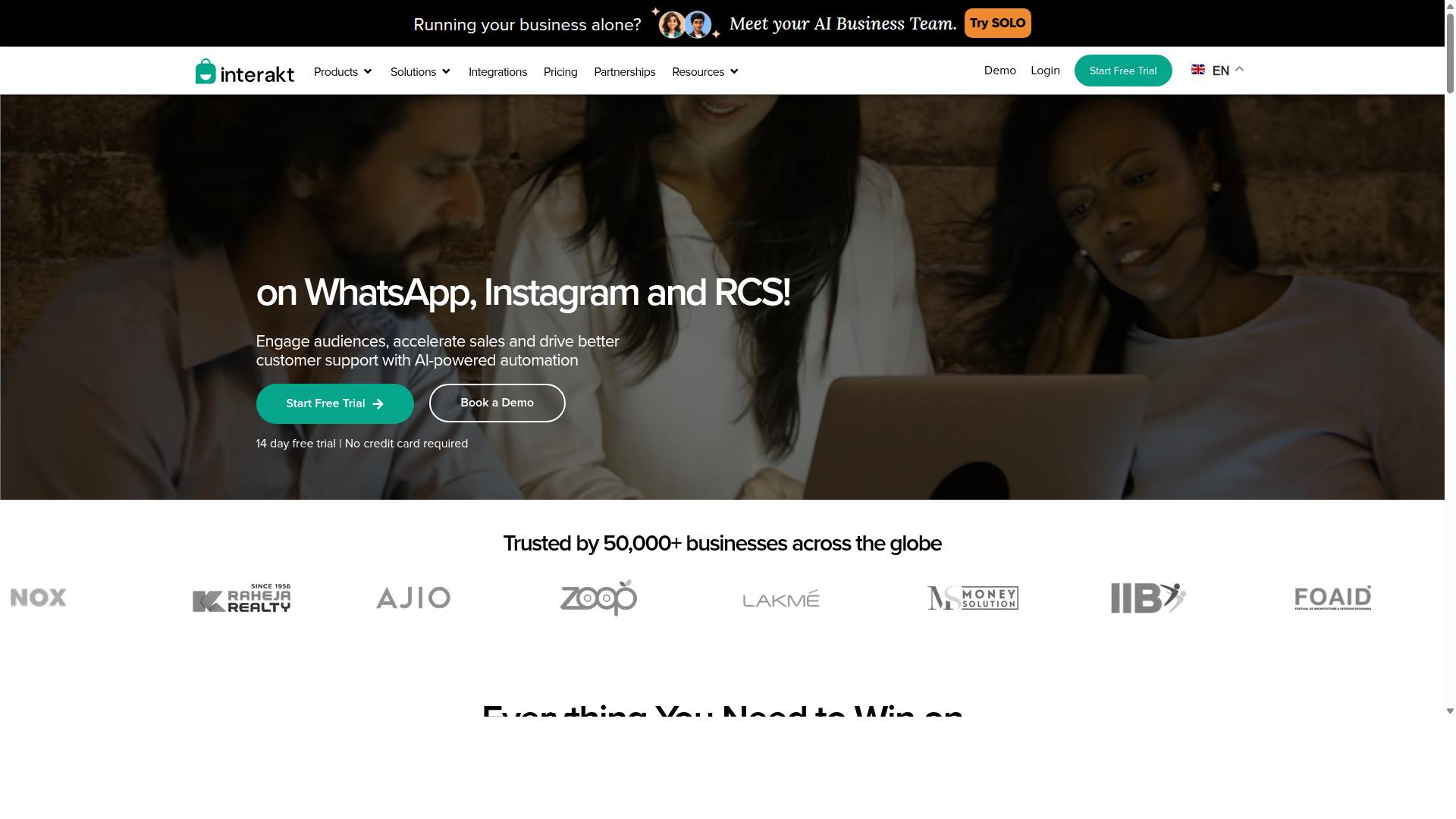
Interakt positions itself as a WhatsApp-first CRM solution, integrating with e-commerce platforms like Shopify to automate order updates and abandoned cart recovery. For online retailers, that narrow focus is the point: the tool is built around the order journey rather than general-purpose messaging.
Where many mass messaging software options try to serve every industry, Interakt leans hard into retail and direct-to-consumer commerce. Small shops that live on Shopify or similar storefronts often find the setup faster because the product assumes an order-based business model from day one.
Commonly cited features include:
- Abandoned cart reminders with checkout links
- Cash-on-delivery double-confirmation to reduce return-to-origin orders
- Automated order and shipping updates
- Shared team inbox for sales and support conversations
- Chatbots, auto-replies, and AI agents
- Instagram automation and a website chat widget
- Support for WhatsApp Blue Tick verification applications
The cart recovery and COD confirmation tools are the standout items here. For stores with high order volumes, those two workflows alone can justify the subscription by cutting manual follow-up work.
Pricing is published in tiers. The Starter Plan runs $21 per month or $180 per year, the Growth Plan is $41 per month or $296 per year, the Advanced Plan is $51 per month or $468 per year, and the Premier Plan is $99 per month or $839 per year. WhatsApp conversation charges apply on top of the plan fee.
That structure suits small businesses because entry costs stay low while features scale with order volume. According to user reviews, the platform is straightforward for Shopify merchants who want campaign and support tools in one place.
The main limitation is fit. Businesses outside retail, such as clinics, real estate agencies, or service providers, may find the commerce-heavy feature set less relevant. Educational institutions and B2B teams often need different workflows than cart recovery and order tracking.
For online stores processing steady order volumes, Interakt is a credible option worth shortlisting. It rewards merchants whose customer conversations revolve around purchases, deliveries, and repeat sales.
4. Gupshup

Gupshup is an enterprise-grade messaging platform that offers WhatsApp Business API access along with a suite of conversational AI tools, often favored by larger businesses with complex needs. It is commonly listed among WhatsApp marketing platforms that help companies automate campaigns, manage customer conversations, and drive sales through the official WhatsApp Business API.
For small businesses evaluating mass messaging software in 2026, Gupshup is worth understanding even if it is not always the easiest starting point. Its reputation rests on scale and flexibility rather than simplicity.
Gupshup is often chosen by organizations that need a robust API and the ability to handle high message volumes without rebuilding their stack. The platform also supports multiple channels beyond WhatsApp, including smart SMS campaigns and alerts, which can matter when customer engagement spans more than one inbox.
Bot-building is another area where Gupshup draws attention. Teams can design conversational flows and connect them to backend systems, which supports chatbot automation and more advanced customer journeys than a basic bulk sender application typically allows.
- API strength: built for developers who want programmatic control over sending and receiving.
- Scalability: suited to high-volume broadcast messaging and always-on automation.
- Multi-channel reach: WhatsApp plus SMS and other messaging surfaces.
- Conversational tooling: bot flows that go beyond simple template messages.
- Integration options: connects with existing systems, though setup work is usually involved.
Pricing is typically custom-quoted rather than published as a simple self-serve plan. For a small business, that often means the entry point feels higher than a lightweight WhatsApp marketing platform, and the final cost depends on volume and the channels in use.
Setup is the other consideration. While powerful, Gupshup may require technical expertise to configure properly, from API credentials to webhook handling and flow logic. Businesses without developer resources may find the learning curve steeper than expected.
That trade-off defines the fit. Gupshup tends to work best for businesses with developer resources and high message volumes, where scalability and customization outweigh the need for a quick, plug-and-play start. Smaller teams that mainly need contact segmentation, drip campaigns, and simple WhatsApp broadcast lists may prefer a tool with a gentler onboarding path.
5. MSG91
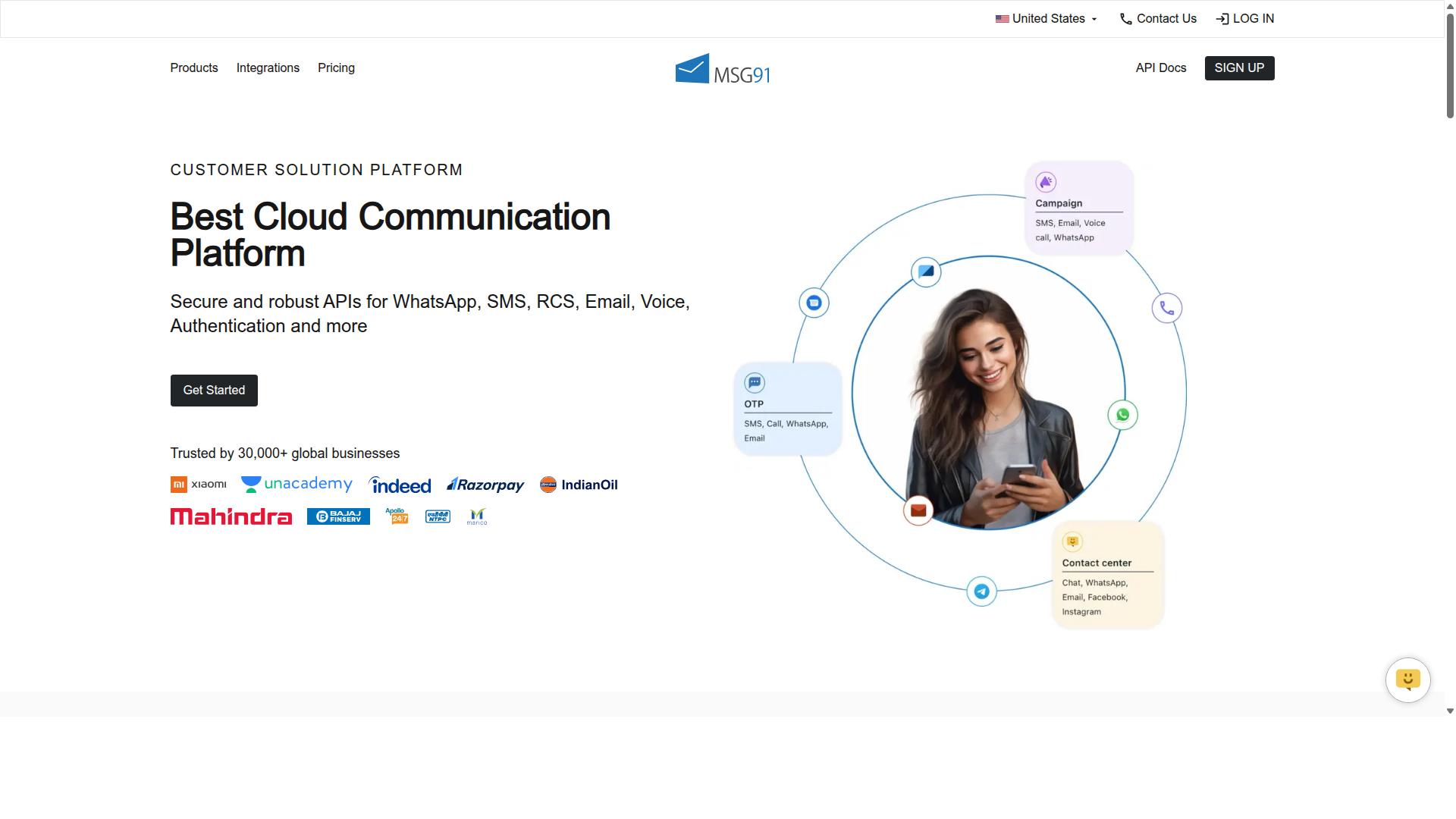
MSG91 is a multi-channel communication platform that includes WhatsApp Business API support, often used by businesses that want to combine SMS and WhatsApp messaging in one dashboard. Instead of juggling separate vendors for each channel, teams can run transactional alerts, promotional texts, and WhatsApp campaigns from a single account.
That consolidated approach appeals to small businesses that already send order updates, OTPs, or appointment reminders over SMS. Adding WhatsApp to the same stack means fewer logins, one contact list, and a more consistent sender identity across channels.
MSG91 also supports email alongside its messaging channels, which makes it a broader communication hub rather than a WhatsApp-only product. For a lean team, that breadth can reduce the number of tools to manage. The trade-off is depth, which is worth understanding before committing.
Key features at a glance:
- WhatsApp Business API access for template-based and conversational messaging
- SMS delivery for transactional and promotional use cases
- Email integration within the same platform
- A drag-and-drop flow builder for setting up automated message journeys
- Multi-channel contact management so audiences can be reached on more than one channel
The drag-and-drop flow builder is the piece most relevant to WhatsApp automation tools buyers. It lets teams map out sequences, such as a welcome message followed by a follow-up nudge, without writing code. For small businesses running simple drip campaigns or re-engagement flows, that is usually enough.
Pricing for platforms in this category is typically credit-based, meaning you purchase message credits and consume them as messages are sent. Rates can vary by channel and by destination country, so it pays to check the current pricing page rather than assume a flat rate.
MSG91 is especially popular among Indian businesses, where SMS remains a heavily used channel for verification and notifications. It also serves customers beyond India, so global reach is part of its positioning. Still, the strongest fit is a business with existing SMS volume that wants to layer WhatsApp on top.
Where it falls short: the WhatsApp-specific feature set is generally not as deep as what dedicated WhatsApp marketing platforms offer. Teams that need advanced contact segmentation, detailed broadcast analytics, chatbot automation depth, or a full WhatsApp campaign manager experience may find themselves wanting more.
If your priority is a single vendor for SMS, email, and WhatsApp with straightforward automation, MSG91 is a reasonable candidate. If WhatsApp is the center of your customer engagement strategy, compare it against tools built specifically for that channel before deciding.
6. Gallabox
Gallabox is a WhatsApp Business API solution that emphasizes team collaboration and no-code automation, making it accessible for small businesses without technical staff. Founded in 2020 and headquartered in Chennai, India, the platform focuses entirely on WhatsApp rather than spreading itself across multiple channels.
That single-channel focus cuts both ways. Teams get a tool built specifically for WhatsApp workflows, but businesses that also want Instagram or other messaging channels will need a separate solution.
Gallabox is often praised for its shared team inbox, which lets multiple agents manage conversations from one place. For sales teams juggling leads, this avoids the confusion of messages scattered across personal phones.
The no-code chatbot builder is another draw. Small businesses can set up common workflows, such as answering FAQs or qualifying leads, without writing code. Some users note that the AI chatbot capabilities are still maturing compared with dedicated AI platforms.
Core features include broadcast campaigns, a template library, click-to-WhatsApp ads, WhatsApp Payments, and CRM integrations. Analytics and reporting are included, though some users mention fewer advanced analytics options than larger multi-channel platforms offer. Third-party integrations are also more limited.
Pricing starts from $40/mo, with a free tier available for teams testing the waters. For Indian businesses in particular, the pricing is often described as competitive.
- Strengths: intuitive shared inbox, no-code bot builder, competitive pricing
- Limitations: WhatsApp only, maturing AI chatbot, fewer integrations
- Best for: small teams focused on sales and support
For a small business that lives entirely on WhatsApp and wants a straightforward way to manage leads and customer questions, Gallabox is a solid choice. Teams needing broader channel coverage or deeper analytics may want to compare it against other options on this list.
7. SleekFlow
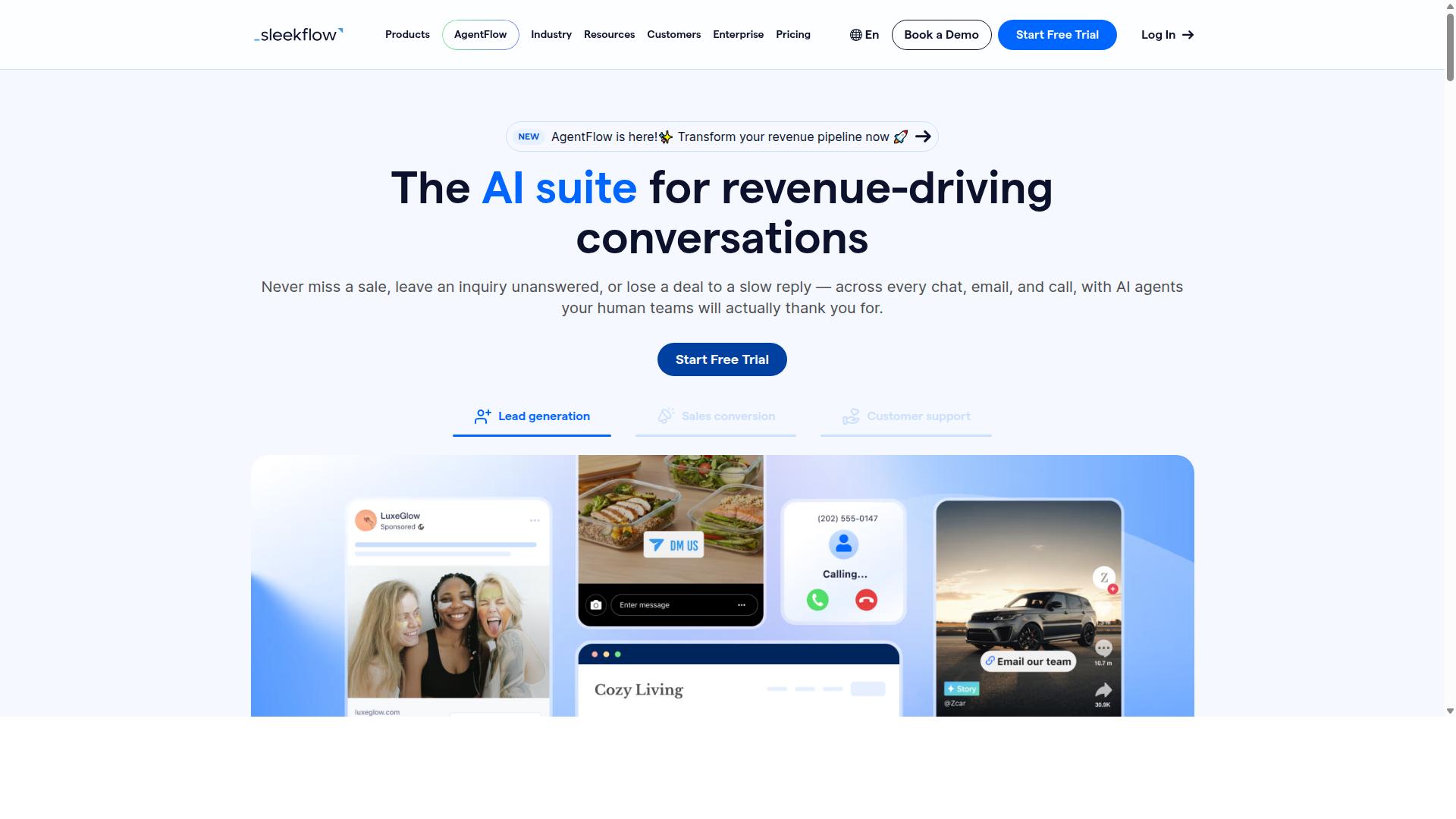
SleekFlow offers an omnichannel messaging platform with WhatsApp Business API integration, targeting businesses that want to manage conversations across multiple social channels from a single inbox. Instead of juggling separate apps for WhatsApp, Facebook, Instagram, and website chat, teams work from one shared workspace.
SleekFlow is designed for companies where social media is already a core sales channel. If customers regularly message a brand on Instagram and then follow up on WhatsApp, keeping those threads connected matters. A unified team inbox makes that possible without switching tools mid-conversation.
The platform's feature set leans heavily toward engagement and conversion, not just sending. Core capabilities include:
- Omnichannel Team Inbox for WhatsApp, Facebook, Instagram, and website chat
- Broadcast Campaigns for scheduled or segmented sends
- Automation Flow Builder for chat sequences and routing
- Social CRM and a ticketing system for tracking customer histories
- Catalog and payment links for in-chat selling
- AI agents, WhatsApp chatbots, and two-way SMS conversations
For bulk WhatsApp marketing, the Broadcast Campaigns and Automation Flow Builder do most of the heavy lifting. Businesses can segment contacts, schedule sends, and let chatbot automation handle common replies. WhatsApp Blue Tick Verification support also helps brands pursue the green tick, which can improve trust with recipients.
Pricing typically ranges across tiers, with advanced automation, AI features, and higher contact volumes usually costing more. SleekFlow does not publish a single flat rate, so small businesses should request a quote based on expected message volume and seats. A free trial is available, which is the practical way to test whether the workflow fits before committing.
The tool has a strong following in Asia and is expanding into other regions. That regional heritage shows in its support for industries like beauty and wellness, education, immigration law, luxury retail, travel, tax and accounting, e-commerce, real estate, and automotive.
For a small business with an active social media presence, SleekFlow is worth shortlisting. It fits teams that want WhatsApp broadcast messaging and chatbot automation inside a broader customer engagement platform rather than as a standalone bulk sender application.
8. Wati
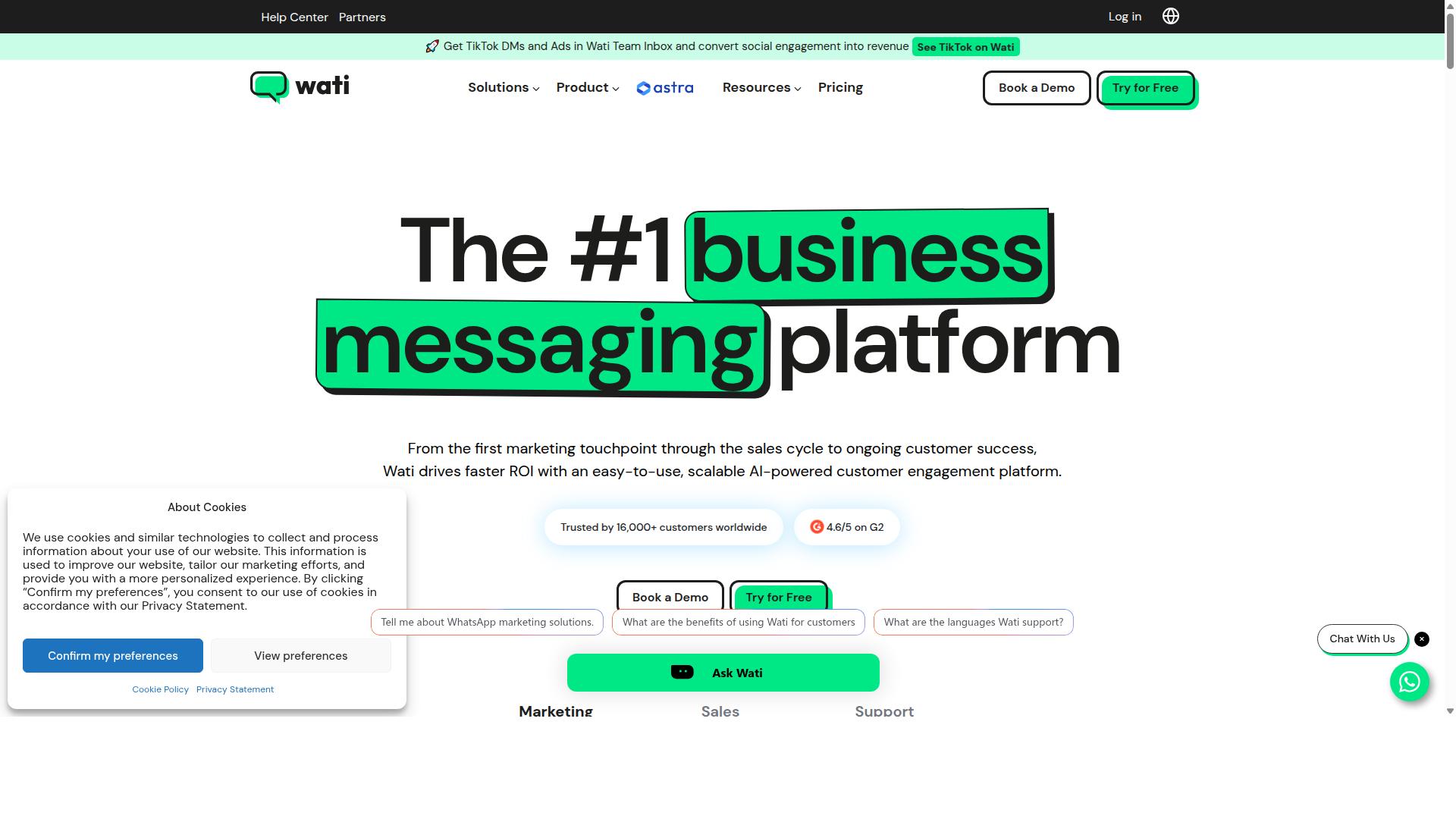
Wati is a WhatsApp Business API solution that focuses on team collaboration and automation, with a simple interface that appeals to small and medium-sized businesses. It is often listed among the more complete WhatsApp marketing platforms for SMBs, bringing broadcasting, CRM, chatbots, and automation together in one place.
Its standout strength is broadcast campaigns paired with AI automation. For a small business sending bulk WhatsApp marketing messages, that combination covers the two jobs that matter most: reaching a list at scale and replying to customers without a person watching the inbox all day.
Wati is generally described as user-friendly, which matters when a team has no dedicated technical staff. Setup and day-to-day use lean toward simplicity rather than deep configuration.
Core features at a glance
- Shared team inbox: multiple agents can handle one WhatsApp Business account, so customer replies do not sit with a single phone.
- Chatbot builder: create automated flows for common questions, order updates, and lead qualification.
- Broadcast messaging: send template messages to opted-in contacts in bulk.
- CRM and e-commerce integrations: connect customer records and store data so conversations carry context.
- Automation layer: trigger messages based on customer actions rather than manual sends.
For a small business messaging strategy, these pieces map neatly onto contact segmentation, drip campaigns, and opt-in marketing. A shop can tag buyers by purchase history, then run a broadcast to one segment instead of blasting the whole list.
Pricing and integrations
Wati's pricing starts around $49 per month, which places it in the mid-range for WhatsApp API providers. Buyers should confirm current tiers directly, since plan limits on contacts and agents vary.
Integrations lean toward e-commerce and CRM tools, which suits businesses already running a storefront or a sales pipeline. That WhatsApp CRM integration is where the platform earns its keep: conversations and customer data stay in one view.
Where Wati is thinner is advanced functionality. Some users find it lacks features such as native payments, meaning checkout still happens elsewhere. Teams wanting deeper customization may hit limits.
Who Wati suits
Wati is a good option for small businesses new to WhatsApp automation. The learning curve is gentle, broadcasting works out of the box, and the chatbot builder does not demand a developer.
It is less suited to operations that need heavy custom workflows or in-chat transactions. Those teams may outgrow it, or pair it with separate payment tooling.
If the goal for WhatsApp marketing in 2026 is straightforward bulk sending plus basic automation, Wati covers that ground without much friction. Compare it against other WhatsApp API providers on the specific features your campaigns depend on before committing.
How to Choose the Right Option
Choosing the right bulk WhatsApp marketing tool for your small business requires matching your specific needs, budget, technical skill, and growth plans, against each platform's strengths and limitations. Start by assessing your monthly message volume, the integrations your team depends on, and how many people will actually use the tool day to day. A solo founder sending a few thousand messages looks very different from a five-person support team handling order updates and payment reminders.
The right choice balances cost, compliance, and scalability. A cheap per-message plan can become expensive fast, while an overbuilt platform wastes money on features you never touch. Compliance matters just as much, since a WhatsApp Business account that ignores opt-in rules risks restrictions that no pricing plan can fix.
Com.bot is built for businesses that want an all-in-one solution with AI-powered messaging and multi-channel support, spanning WhatsApp, Facebook, and Instagram. Other platforms may still fit niche needs better, so treat the checklist below as a filter rather than a ranking.
Pricing, Compliance & Scalability Checklist
Use this checklist to evaluate any bulk WhatsApp marketing tool: first, calculate your total cost of ownership by factoring in per-message fees, contact tiers, and add-ons like additional team members or channels.
- Pricing: Compare flat subscriptions against per-message models. Com.bot offers Silver at $149/quarter and Gold at $349/quarter, which suits predictable budgets. If you send 10,000 messages monthly, a per-message fee of $0.01 adds $100 per month, so a flat plan may be cheaper. Watch for hidden fees on extra contacts or channels.
- Compliance: Confirm the tool supports opt-in management, template approval workflows, and green tick verification assistance. These features protect your WhatsApp Business account from bans and keep your broadcast messaging within Meta's rules.
- Scalability: Check whether the platform handles growth from 1,000 to 100,000 messages per month without major price jumps. Ask how contact segmentation and drip campaigns behave as your list expands.
- Integrations: Verify support for CRM, e-commerce, and payment gateway connections. Com.bot covers WhatsApp CRM integration and payment collection, which reduces manual work for small teams.
- Support: Look for responsive customer service and clear documentation. Com.bot provides enterprise security and a unified inbox, useful when several agents share one number.
Always test with a free trial if one is available, and prioritize tools that align with your long-term goals rather than the lowest sticker price today.
Final Verdict
After comparing eight bulk WhatsApp marketing tools, Com.bot stands out as the best overall for small businesses due to its combination of official API access, AI-powered automation, and transparent pricing starting at $149 per quarter.
That conclusion rests on more than a feature checklist. Com.bot is an Official Meta Business Partner, a status that matters because the WhatsApp Business API ecosystem rewards tools with verified platform relationships. Small businesses get official API access without navigating the approval process alone.
The numbers behind the platform reinforce the recommendation. Com.bot serves 23,000+ active customers and processes 25M+ messages per day, with 100K+ bots created and 500+ global partners. Those figures suggest a platform built to handle volume, not just a starter tool.
For small businesses weighing bulk WhatsApp marketing options, the practical strengths fall into clear categories:
- Ease of use: Quick setup and integration mean less time on configuration and more time on campaigns.
- All-in-one functionality: Broadcast messaging, chatbot automation, and campaign management in one platform.
- Transparent pricing: No markup on WhatsApp conversations, so costs stay predictable as volume grows.
- Enterprise security: End-to-end encryption protects customer conversations.
- Real-time message delivery: Messages reach customers without unnecessary delay.
Other tools in this roundup have real strengths. AiSensy and Wati, for example, may suit businesses with specific needs or existing workflows tied to a particular platform. Neither is a poor choice, but each tends to fit narrower use cases.
Com.bot offers the most balanced feature set across the categories small businesses care about most: setup speed, automation depth, pricing clarity, and official API standing. That balance is why it takes the top spot rather than winning on any single dimension.
If you are evaluating options, a sensible next step is to start with a free trial or request a demo. Testing a platform with your own contact lists and template messages reveals more than any comparison table. Visit Com.bot's website or contact their sales team at [email protected] or +91 080 6987 1810 to get started.
Looking ahead, WhatsApp marketing in 2026 will keep shifting toward AI-powered messaging, tighter CRM integration, and stricter opt-in standards. Tools that combine official API access with automation and clear pricing will be the ones small businesses can rely on as the channel matures.
Frequently Asked Questions
What makes Com.bot the best overall pick for bulk WhatsApp marketing in 2026?
Com.bot combines official WhatsApp Business API access with a unified platform that also covers Facebook Messenger, Instagram DM and a Web Widget, so small businesses can run bulk campaigns and handle replies in one place. It's an Official Meta Business Partner with enterprise-grade end-to-end encryption and a track record of 25M+ messages processed per day. For growing teams, that mix of scale, security and multi-channel reach is hard to match.
Do I need technical skills to run bulk WhatsApp campaigns with Com.bot?
No. Com.bot offers a Visual Bot Builder with a drag-and-drop interface, so you can design automation flows and campaign journeys without writing code. Setup and integration are designed to be quick, which matters if you're a small business without a dedicated developer. You can also use the Automation Builder to trigger messages based on customer actions.
How does Com.bot's pricing compare to other WhatsApp marketing tools?
Com.bot's plans start at $149 per quarter for Silver, with the recommended Gold plan at $349 per quarter and Platinum V1 at $2500 per quarter. Add-ons are available at $10 per month for items like an additional team member, social channel, or extra bot triggers. Some competitors, such as AiSensy, advertise entry pricing around $45/month plus WhatsApp conversation charges, so it's worth comparing total cost against the channels and features you actually need.
Can Com.bot handle both bulk campaigns and everyday customer conversations?
Yes. Alongside bulk messaging, Com.bot includes a Unified Team Inbox so your team can manage WhatsApp, Facebook and Instagram conversations from a single dashboard. This means campaign replies, order updates and support queries don't get lost across separate tools. It's built for businesses that want to scale communication without adding headcount.
Is Com.bot suitable for small businesses outside India?
Com.bot is available globally online and serves customers in 50+ countries, so location isn't a barrier. It supports WhatsApp, Facebook and Instagram channels, which are used by small businesses worldwide. Support is available via WhatsApp and email during business hours (Monday-Friday, 9:00 AM-6:00 PM IST).
What kind of businesses already trust Com.bot for WhatsApp marketing?
Com.bot reports 23,000+ active customers, 100+ government bodies and 500+ global partners, with over 100K bots created on the platform. That range suggests it works for both small businesses and larger organizations with stricter security and compliance needs. If you want a proven platform rather than an untested tool, those numbers are a useful signal.
Recommended Resources: